Repression to mask deeper failures
Across Burkina Faso, Mali, and Niger, the military governments forming the Alliance of Sahel States (AES) are tightening their grip. This era is marked by widespread repression, including arbitrary detentions and abductions, alongside severe restrictions on fundamental freedoms. These actions highlight deep legitimacy crises within these regimes, creating immense challenges for human rights advocates and journalists.
“Those who live by the sword will die by the sword,” a sentiment echoed by Alioune Tine, president of Afrikajom Center, when discussing the current climate. Tine observes that the government led by Ibrahim Traoré is facing significant struggles. He asserts that military authorities in Burkina Faso, Mali, and Niger are caught in a profound dilemma. The primary justification these regimes offered for seizing power was the deteriorating security landscape. However, the security situation has, in many instances, become even more alarming than it was prior to their takeovers. Tine adds, “When power is seized by force, there is always the constant fear of losing it by force.”
Reflecting on the past, Mr. Tine also recalls Captain Ibrahim Traoré’s initial pledge to swiftly restore civilian rule. Yet, today, Traoré not only shows no inclination to hold elections for Burkinabé citizens to choose their leaders but increasingly relies on repressive tactics to cling to power. Tine quotes Traoré’s early statement: “The deadline set by ECOWAS is too long; we will quickly hold an election and return power to civilians.” Tine emphasizes that “all these promises have gone unfulfilled. The human rights situation is now worsening dramatically. We are witnessing what amounts to a massacre against certain communities, particularly the Peuls. This is an extremely alarming situation,” the human rights defender concluded.
Military regimes face an impasse
Despite official narratives and propaganda, the country’s security situation continues to deteriorate, marked by increasingly frequent attacks that contribute to an already heavy death toll. A recent example is the Mansila attack on June 11, which reportedly resulted in approximately one hundred fatalities, according to various sources. The BBC reported that these events “are rumored to have significantly impacted troop morale,” further noting that “access to the town is impossible without a military convoy, and communication networks are down. It is virtually impossible to reach local contacts.”
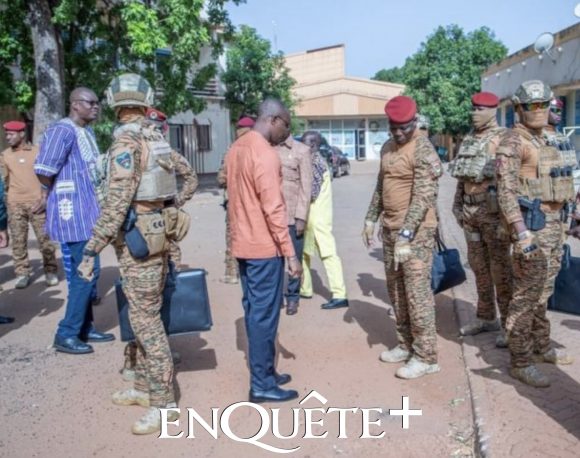
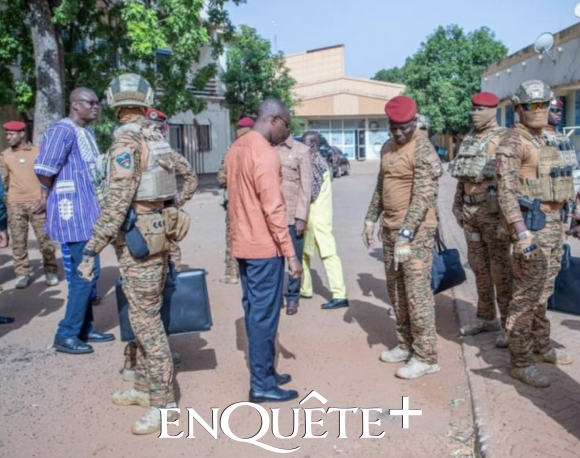
Amidst this volatile backdrop, and following a period of silence from the junta leader, an artillery shell reportedly landed in the courtyard of the public television station (RTB) on June 12, causing several injuries. This incident sparked confusion in Ouagadougou, with some speculating about barracks mutinies or even attempted coups. Captain Ibrahim Traoré eventually broke his silence to quell anxieties and reassure the populace. During a visit to RTB, which typically followed the weekly Council of Ministers meeting, he dismissed the shell incident as minor. Traoré urged Burkinabé citizens to disregard “enemy media” spreading “fake news,” asserting that rumors of mutiny, dissent, or coups were “imaginary.” To those suggesting his position was vacant, he defiantly responded, “If the post is vacant, let them come and take it. They understand nothing. These people have been paid to lie.”
One hundred soldiers killed in Burkina, widespread suspicion within ranks
The unfolding crisis in Burkina Faso has drawn sharp condemnation from Amnesty International and the Coalition sénégalaise des défenseurs des droits humains. Both organizations are planning a peaceful demonstration to protest the “repression of press freedom and freedom of opinion and expression” within the nation. They demand the “release of human rights defenders who are either imprisoned or forcibly conscripted into the Volunteers for the Defense of the Homeland, including lawyer Guy Hervé Ham, detained since January 24.”
The events in Burkina Faso are indicative of the broader challenges faced by military-led nations across the region. Initially hailed as saviors upon taking power, these regimes have largely failed to outperform the elected governments they overthrew, with only rare exceptions.
In Mali, despite some reports acknowledging genuine efforts to control the northern territories, fundamental issues persist. The socio-economic situation, in particular, continues its downward spiral. Alioune Tine describes this as “a failure. Similar to Burkina Faso, all these countries are in a kind of deadlock. Their leaders not only lack legitimacy but also fail to alleviate the suffering of their populations. In Mali, exiled opposition figures have even formed a parallel government, highlighting a profound crisis of legitimacy.”
Alioune Tine: “ECOWAS is divided between pro-Russian and pro-Western factions”
Confronted by escalating challenges to their authority, military regimes increasingly employ tactics of terror. Juntas are perpetrating numerous abuses to maintain control, including arbitrary detentions, abductions of human rights defenders, and the closure of both domestic and international media outlets. Alioune Tine describes the emergence of “total dictatorships.” He states, “They even dare to abduct civil society figures. It’s a true dictatorship. People are taken and sent to the front lines. Even 70-year-olds are abducted and forced into combat.” Driven by political expediency, these regimes have sought protection from nations with questionable human rights records, such as Russia. Tine laments this development: “Unfortunately, the integration dynamics within ECOWAS have been shattered by playing into the hands of major global powers. ECOWAS is now entirely fractured between those perceived as pro-Western or pro-French and those aligned with Russia. This undermines inter-African cooperation, creating a catastrophe for the sub-region. I believe ECOWAS must also reassess its approach to better address the concerns of its people, especially the youth.”
Among these pressing concerns are the future of the CFA franc and the presence of foreign military bases. Tine remarks, “My only regret concerning military bases is the lack of viable alternatives following the departure of French forces.”