The political landscape in Senegal has long been shaped by shifting alliances, whether within a single party or across party lines. This fluidity, as Lord Palmerston noted in 1848, follows the principle that “in politics, there are no permanent enemies or permanent friends—only permanent interests.”
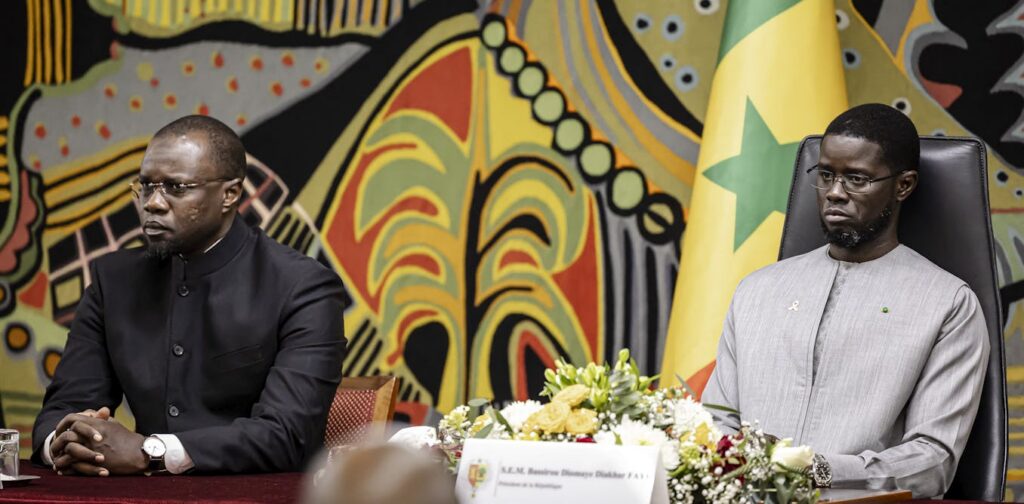
The cohabitation between President Bassirou Diomaye Faye and Prime Minister Ousmane Sonko, once hailed as a unified force, now faces a sharp deterioration. What began as a harmonious partnership has crumbled into open discord, culminating in the dismissal of the Prime Minister and the dissolution of the government on May 22.
Early tensions surfaced during the November 8, 2025 rally, where signs of internal friction emerged. However, it was the May 2, 2026 meeting that removed all ambiguity. The President openly criticized his Prime Minister, condemning the “excessive personalization of power” around Sonko, signaling a definitive break in their once-cohesive alliance.
the myth of a unified leadership
The Sonko-Diomaye pairing was forged under extraordinary circumstances: after Sonko’s candidacy was invalidated, he strategically backed Diomaye for the presidency. Initially, their roles seemed complementary—Diomaye managed state affairs while Sonko provided strong political legitimacy. Yet the November 8, 2025 rally exposed the fragility of this arrangement.
The slogan “Sonko mooy Diomaye” (Sonko is Diomaye, in Wolof), once a unifying rallying cry against the previous administration, has lost its potency. Today, separate slogans like “Sonko est Sonko” or “Ousmane est Sonko” reflect a growing divide. This shift reveals not just a personal rift but a structural clash between two visions of governance.
The fusion of their political identities created a powerful symbolic capital—a perception of an indivisible leadership. Followers of the PASTEF movement no longer saw two distinct leaders but a single, cohesive force. Yet, this illusion was unsustainable. The Senegalese presidential system, as defined by the Constitution (Articles 42–52), demands a clear separation of powers. The President’s authority cannot be shared.
Diomaye’s institutional role demands a sovereign posture, while Sonko retains his mobilizational, disruptive style. As sociologist Pierre Bourdieu observed, “the role shapes the man more than the man shapes the role.” Diomaye’s resignation from his PASTEF leadership positions was a necessary step to uphold institutional integrity, yet it deepened the divide. The shift from street-level messaging—“Diomaye est Sonko”—to formal, protocol-driven communication has further entrenched their separation.
the mechanics of power and rivalry
In fluid dynamics, two bodies sharing an envelope will compress one another based on mass. Applied to this political duo, the balance of power is anything but static. Sonko’s influence stems from his popular legitimacy and control over the party, while Diomaye’s authority lies in executive decrees and state decisions.
When Sonko’s influence expands too far, it encroaches on Diomaye’s institutional domain, risking the perception of a President under tutelage. Conversely, if Diomaye asserts too much autonomy, he risks losing Sonko’s vital source of legitimacy. This interdependence creates a delicate equilibrium—one that perpetuates a “soft rivalry.”
Their rivalry intensifies as they mirror each other’s ambitions. Both seek the same goals: power, presidency, and leadership. Sonko’s aspiration for executive control clashes with Diomaye’s determination to consolidate his presidency. This dynamic mirrors the “number two syndrome,” where a once-loyal deputy turns against their leader upon gaining prominence. The original leader, driven by electoral caution, may then view the deputy as a potential threat, fostering mutual distrust and paranoia.
The consequences are far-reaching. Social unrest and political instability loom as this power struggle reshapes alliances within PASTEF and beyond. The myth of a “gentlemen’s agreement” in politics proves fragile when ambition and institutional constraints collide.