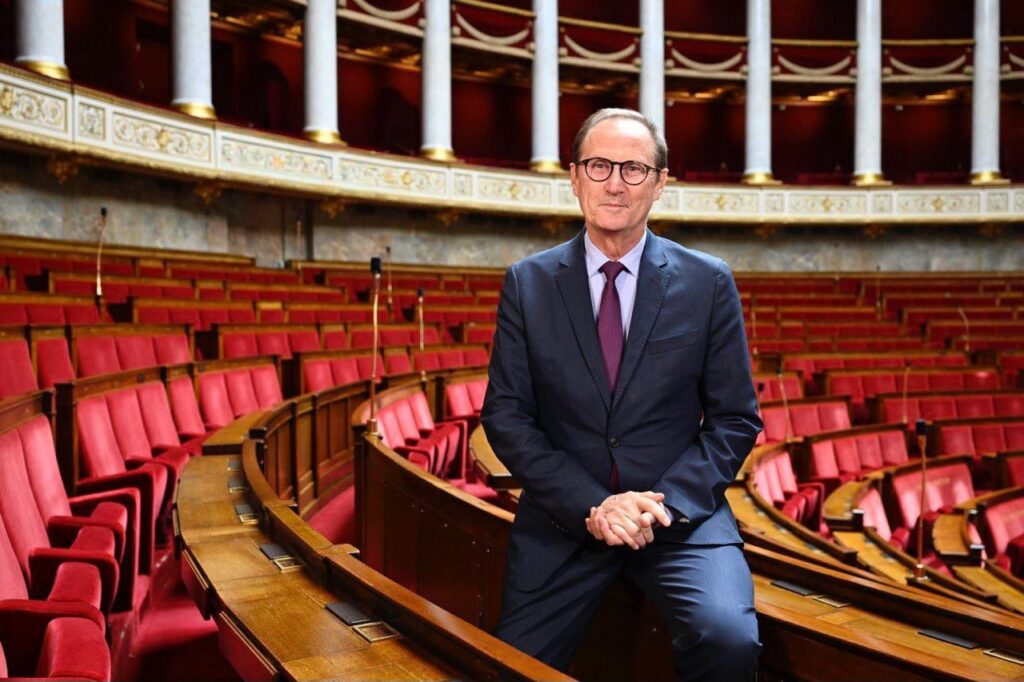
As Mali grapples with deepening instability, French political figures are increasingly vocal about potential diplomatic solutions to the crisis. Bruno Fuchs, chairman of the French National Assembly’s Foreign Affairs Committee and a close associate of President Emmanuel Macron, has publicly advocated for negotiations with the Jama’at Nusrat al-Islam wal Muslimin (JNIM), an armed group linked to al-Qaida.
Speaking in an exclusive interview, Fuchs outlined his vision for Mali’s political future, emphasizing the urgent need for dialogue to prevent further deterioration. His remarks came amid persistent rumors of Russia’s impending withdrawal from the West African nation—claims Fuchs himself asserted without hesitation.
contradictions and colonial echoes in french foreign policy
While Fuchs framed his position as a break from France’s colonial past, his statements reveal lingering contradictions. He acknowledged persistent grievances in the Franco-African relationship, including the CFA franc and visa policies, yet insisted on France’s continued role in shaping Mali’s trajectory. His assertion that Mali’s military junta is on the brink of collapse—contrasted with calls for negotiation—underscores the complexity of the situation.
When pressed on whether France welcomed Russia’s struggles in northern Mali, Fuchs sidestepped the question, instead reiterating Macron’s earlier claim that France’s departure from Mali was a strategic misstep by the junta. He predicted the regime in Bamako would fall within weeks or months, citing pressure from both the Front de Libération du Azawad (FLA) and the JNIM.
the dilemma of negotiating with armed groups
Fuchs’s most provocative proposal centered on the possibility of integrating the JNIM into Mali’s political process. He claimed the group was prepared to lay down arms in exchange for participation in governance, though he offered no explanation for why an armed faction would settle for a secondary role. His hypothetical scenario raised critical questions: Would France and Europe accept a transition where the JNIM holds political influence? His response was equivocal at best.
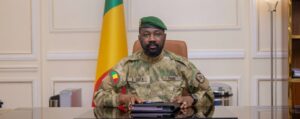
Fuchs outlined two potential paths forward for Mali. The first involves a negotiated transition led by a transitional figure—excluding current leader Assimi Goïta—spanning three to six months, culminating in elections. The second, he warned, would resemble Afghanistan’s collapse, with dire regional consequences. He suggested a federal model inspired by Nigeria, where some states could implement Sharia law while others retain secular governance. However, the feasibility of such a system in Mali’s tightly interconnected communities remains questionable.
Russia’s exit and the scramble for influence
Fuchs asserted that Russia is actively negotiating its withdrawal from Mali, retracting earlier claims of its presence. He speculated that Moscow’s departure hinges on the JNIM’s stance and the junta’s resilience. Notably, he claimed Russia would seek guarantees for its economic interests, particularly gold mining operations, before leaving.
His comments reflect broader French discomfort with Russia’s expanding footprint in Africa, despite Fuchs’s insistence on France’s reliability as a partner. He cited the normalization of relations with Faustin-Archange Touadéra in the Central African Republic—despite Russian involvement—as a model for engagement. Yet, his stance excludes Mali’s ruling Alliance of Sahel States, suggesting a selective approach to diplomacy.
Fuchs’s proposals, laced with contradictions and unproven assumptions, highlight the challenges of reconciling France’s fading influence with the realities of Mali’s evolving alliances.