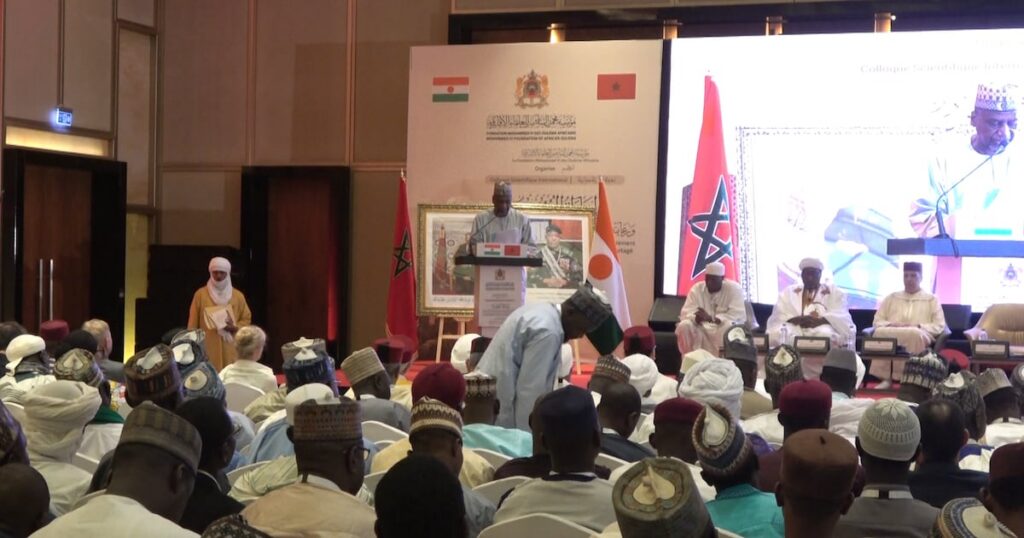
The Mohammed VI Foundation of African Ulemas recently hosted a two-day international symposium in Niamey centered on “The Commandership of the Faithful and its role in shaping Africa’s religious landscape and shared human heritage”.
The event concluded with actionable scientific recommendations aimed at preserving peace, tolerance, and social cohesion across the continent. In a region facing growing ideological divisions, the gathering provided a platform to highlight the principles of moderate Islam and their potential to foster mutual understanding among Muslims, regardless of doctrinal differences.
Promoting peace through religious moderation
Ibrahim Hamgar, Secretary-General of the Mohammed VI Foundation of African Ulemas (Niger branch), emphasized the urgency of the discussion. “In a world—and especially an Africa—plagued by religious polarization, this conference shines a light on the enduring values of moderation and dialogue. The goal is to strengthen peaceful coexistence and social harmony among Muslims, even amid divergent perspectives.”
Niger-Morocco partnership highlighted in Islamic cooperation
Beyond its spiritual and academic focus, the symposium underscored the deepening ties between Niger and Morocco. Mohamed Iboumraten, Morocco’s Ambassador to Niamey, highlighted a flagship initiative: the Imam and Preacher Training Program. Running from 2019 to 2025, this initiative has equipped 200 imams, preachers, and female preachers each year with scholarships and two-year training at the Mohammed VI Institute in Rabat.
The program reflects a broader strategic collaboration between the two nations, particularly in religious education and cultural exchange.
Religion as a pillar of stability in the Sahel
The Secretary-General of Niger’s Ministry of Foreign Affairs, Souleymane Issakou, stressed the pivotal role of faith in building resilient societies. “The presentations and discussions reinforced how religion—when grounded in moderation and dialogue—can serve as a cornerstone for stability, social cohesion, and peace in African societies, particularly in the Sahel, where security and ideological challenges persist.”
Over two days, Niamey became a hub for intellectual exchange, with participants agreeing that sustainable peace is rooted in knowledge, dialogue, and mutual respect.
The closing ceremony featured the presentation of the symposium’s final report, culminating in the adoption of a joint communiqué and a set of policy recommendations designed to guide future efforts.