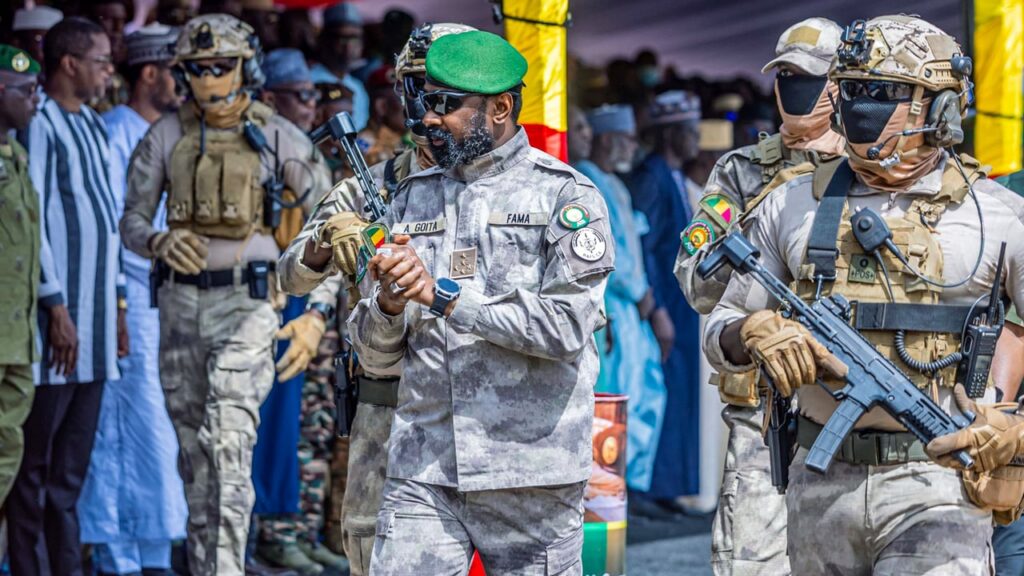

The April 25 attacks in Mali marked a turning point in the consolidation of Assimi Goïta‘s authority. Following the security breach, the transitional leader took decisive steps to reshape the political and military landscape of the country. The events that unfolded in the wake of the incident reveal a calculated strategy to reinforce his position while navigating complex regional dynamics.
Immediate response and security overhaul
In the hours and days following the attacks, Assimi Goïta swiftly restructured the country’s security apparatus. High-level meetings were held in Bamako, where the transitional president reaffirmed his commitment to combating extremist threats. The government announced a series of reforms aimed at strengthening intelligence-sharing mechanisms and deploying additional troops to vulnerable regions.
Key appointments were made, with trusted allies taking charge of critical security portfolios. This rapid reshuffling underscored the president’s determination to assert control over the national security agenda, sending a clear message to both domestic and international stakeholders.
Political maneuvers and institutional changes
The aftermath of the attacks provided Assimi Goïta with an opportunity to tighten his grip on power. Constitutional amendments were fast-tracked, allowing for greater executive authority and streamlined decision-making processes. Critics argue that these changes were pushed through with limited oversight, raising concerns about the erosion of democratic safeguards.
The transitional government introduced new legislation granting the president broader powers to address security challenges, including the authority to bypass parliamentary approval in urgent situations. While supporters praised these measures as necessary for stability, opponents cautioned that they risked undermining Mali’s fragile democratic institutions.
Regional alliances and international reactions
Assimi Goïta‘s leadership during the crisis drew mixed responses from regional partners. Some neighboring countries expressed support for his efforts to restore order, while others voiced skepticism about the long-term implications of his consolidation of power. The president’s alignment with certain foreign actors further fueled debates about Mali’s strategic direction in the face of ongoing security threats.
International observers closely monitored the situation, with some expressing concern over the potential for increased authoritarianism. The Group to Support Islam and Muslims (JNIM) and other militant factions remain active in the region, posing an ongoing challenge to Mali‘s stability.
Economic implications and public sentiment
The security crisis has also had significant economic repercussions. Investor confidence wavered as uncertainty loomed over the country’s political trajectory. Meanwhile, ordinary citizens in Bamako and beyond grappled with the consequences of the attacks, from disrupted daily life to heightened fears about future violence.
Public reactions have been divided. Some segments of society view Assimi Goïta‘s actions as a necessary response to a dire situation, while others perceive them as an overreach that could destabilize the nation further. The coming months will be critical in determining whether the president’s strategy succeeds in restoring peace and security.
What lies ahead for Mali?
The trajectory of Mali in the post-crisis period remains uncertain. Assimi Goïta‘s ability to balance security imperatives with democratic principles will be closely scrutinized. As the transitional government navigates these challenges, the country’s future hinges on its ability to address the root causes of instability while preserving its institutional integrity.
One thing is clear: the events of April 25 have set the stage for a new chapter in Mali‘s history, one that will be defined by the choices made in the days and weeks to come.