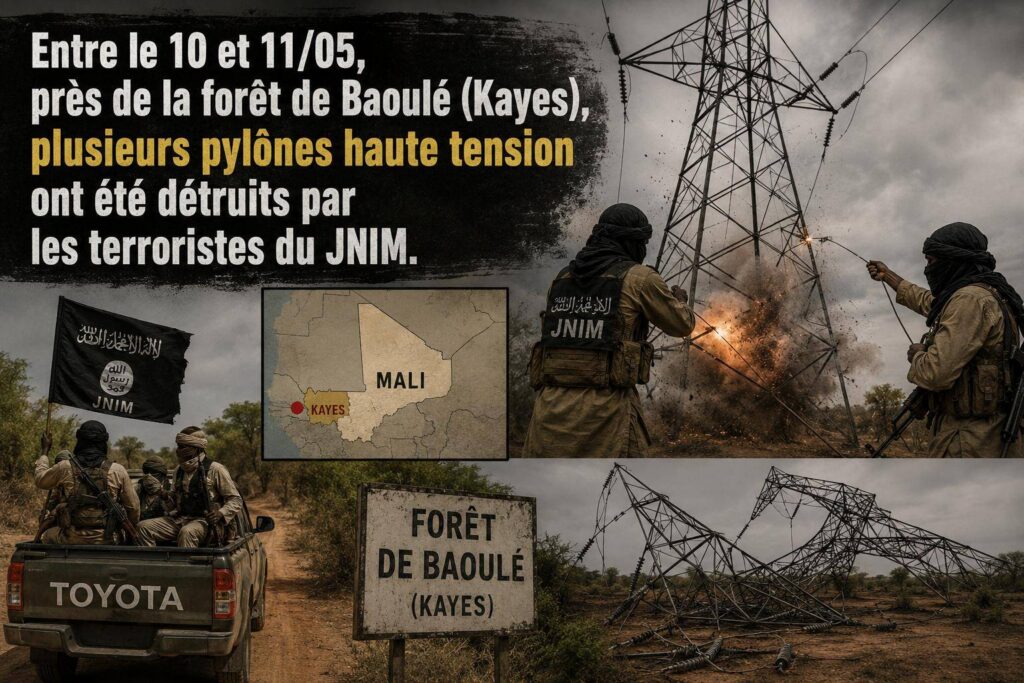
The weekend of May 10-11, 2026, will be etched in Mali’s energy crisis as a turning point. Near the Baoulé forest in the Kayes region, militants from the Group to Support Islam and Muslims (JNIM) executed a coordinated strike, demolishing multiple high-voltage power pylons. This sabotage unfolded under the watch of a key security partner—the Africa Corps—whose on-ground effectiveness is increasingly under scrutiny. With record-breaking heatwaves, severe water shortages, and now total darkness engulfing Bamako, the capital is suffocating as terrorist threats creep closer to the Manantali and Sélingué hydroelectric dams.
JNIM’s calculated assault on Mali’s infrastructure
What began as sporadic rural skirmishes has evolved into a calculated siege targeting Mali’s economic lifelines. After severing critical road arteries into Bamako—torching trucks and civilian buses—the JNIM has escalated its tactics. By striking power transmission lines in Kayes, the insurgents are directly undermining daily life and the stability of the transitional government.
Their operation was meticulously executed. Pylons, nestled in the rugged terrain near the Baoulé forest, were felled with alarming precision. The result? A mass blackout plunging entire neighborhoods into darkness, exacerbating an already fragile energy grid.
Unanswered questions about security promises
The timing of these attacks is particularly damning. Just as Malian Armed Forces and Africa Corps units claimed control over these zones, militants somehow transported explosives, rigged towering metal structures, and vanished undetected. This raises serious doubts about the real-world impact of Bamako’s pivot toward Moscow for security guarantees.
On the ground, the disparity between rhetoric and reality is stark. While Russian paramilitaries excel in urban force displays and propaganda victories, their track record in preventing hybrid attacks on critical infrastructure is dismal. Drones and joint patrols have repeatedly failed to shield the power network, leaving civilians to question the true value of this partnership.
Bamako’s unbearable living conditions
For Bamako’s residents, this sabotage is the final blow to an already unbearable existence. Sweltering heat—temperatures soaring past 45°C—has turned life into a daily ordeal. Without electricity for fans or pumps to deliver clean water, survival feels impossible. Government assurances about fuel convoys guarded by the Malian Armed Forces (FAMa) and Africa Corps ring hollow when backup generators are woefully inadequate. Hospitals, including emergency wards and maternity units, now operate under life-threatening conditions, risking thousands of lives daily.
Manantali and Sélingué: A looming regional catastrophe
The gravest concern? Credible intelligence suggests the JNIM is now eyeing the Manantali and Sélingué dams. This isn’t just Mali’s crisis—it’s a threat to West Africa. These dams are the backbone of the subregion’s energy and water supply, and a successful attack would plunge Bamako into months of darkness while crippling Senegal and Mauritania’s energy-sharing agreements. Irrigated agriculture across the river basin would collapse, triggering a food security nightmare across borders.
The trajectory—from truck burnings to pylon demolitions to potential dam breaches—reveals the JNIM’s escalating strategy of chaos. Yet, the army and its allies remain ill-equipped to counter it. The Africa Corps’ deployment, though costly for Mali’s budget, has failed to secure national infrastructure or protect essential services.
The transitional government and its allies now face an ultimatum. Grand declarations about territorial liberation clash with a harsh truth: the country’s vital infrastructure is crumbling. The time for empty boasts has passed; urgent action is needed to safeguard these vulnerable points. If the dams fall, the Malian state’s credibility will evaporate under the Sahel’s scorching sun. Bamako’s citizens deserve more than hollow sovereignty slogans—they demand water, light, and real security.