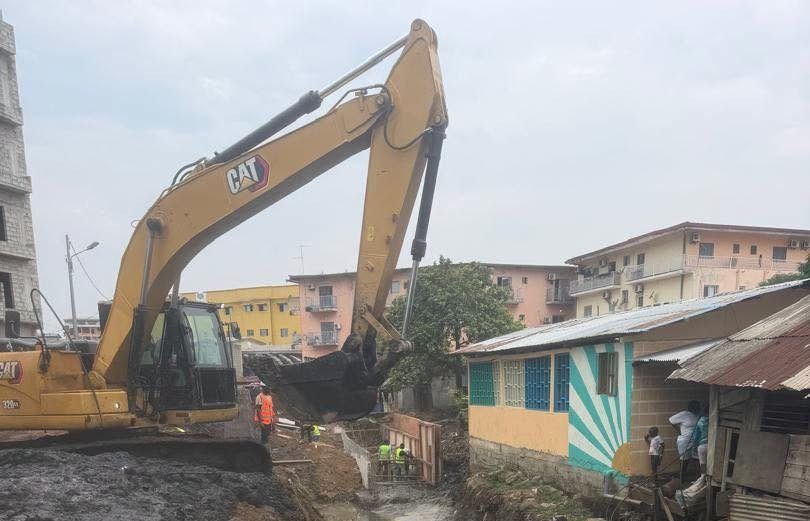
The demolition operations at Libreville’s Baie des Cochons are scheduled to begin on June 26, 2026, following weeks of announcements and consultations. This marks a pivotal moment in the urban transformation of Gabon’s capital, focusing on the strategic third arrondissement area.
Behind the machinery lies more than a simple road project. This is one of the flagship initiatives of President Brice Clotaire Oligui Nguema’s urban modernization policy, aimed at reshaping traffic flow, sanitation, and territorial integration across several Libreville neighborhoods.
The operation covers areas including Sipagel, the Léon Mba intersection, and the corridor along the Gabon Energy and Water Company installations up to the Petit-Paris roundabout. It reflects the authorities’ deliberate choice to prioritize major infrastructure to support urban growth. However, it raises a universal challenge faced by all large African cities: how to modernize without destabilizing communities that have lived there for decades.
Unlocking a capital in transformation
Baie des Cochons holds a strategic position in Libreville’s spatial layout. Located at the heart of dense economic and human flows, the area has long been a major congestion point between Mont-Bouët market, the city center, Boulevard Bessieux, and several peripheral districts.
The government plans to build a new main axis with secondary roads to ease traffic and strengthen connections between the Libreville University Hospital, Petit-Paris, the Léon Mba intersection, and surrounding areas.
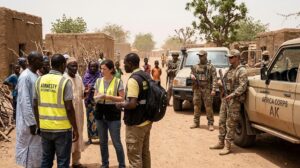
During a site visit on June 23, Housing, Urban Planning and Cadastre Minister Mays Mouissi directly explained the project’s objectives to residents. Authorities state that clearing public land is a necessary step before the awarded contractor can begin construction.
Beyond traffic, the project aims to tackle a recurring issue affecting thousands of residents each year: flooding. The plan includes cleaning existing drainage channels, rehabilitating damaged hydraulic structures, and building new stormwater evacuation systems.
For the authorities, this means addressing two major urban emergencies simultaneously: mobility and sanitation.
The social test of large urban transformations
As with all large-scale development operations, future benefits come with immediate consequences for affected populations.
Some families have occupied the targeted spaces for many years. Others have built economic activities that sustain their daily livelihoods. The prospect of demolitions naturally raises questions, concerns, and expectations.
Recent history of major urban operations across Africa shows that success is measured not only by road quality or infrastructure modernity, but also by the authorities’ ability to manage the transition humanely.
Compensation, potential relocations, protection of local economic activities, and social support become as critical as the construction itself.
Aware of this challenge, the ministry says it prioritized dialogue with residents before operations began. The coming weeks will test the effectiveness of this approach and the government’s ability to balance the public interest with protecting affected communities.
The real-world test of urban modernization
Baie des Cochons has become a symbol of a city that can no longer develop according to past logics.
Facing population growth, rapid urbanization, and environmental challenges, Libreville must adapt its infrastructure to a new reality. Chronic traffic jams, limited access for emergency services, sanitation problems, and the isolation of certain districts are now hindering the capital’s economic development.
This is precisely what the authorities aim to correct. But the project also represents a major political test of the state’s ability to carry out ambitious urban reforms while preserving social cohesion. A modern city is not built with concrete, roads, and drains alone; it also requires the buy-in of its people.
At Baie des Cochons, Gabon is playing a significant part of its modernization strategy. The first shovel will start the work, but the true success of this transformation will be determined by its concrete impact on residents’ daily lives.