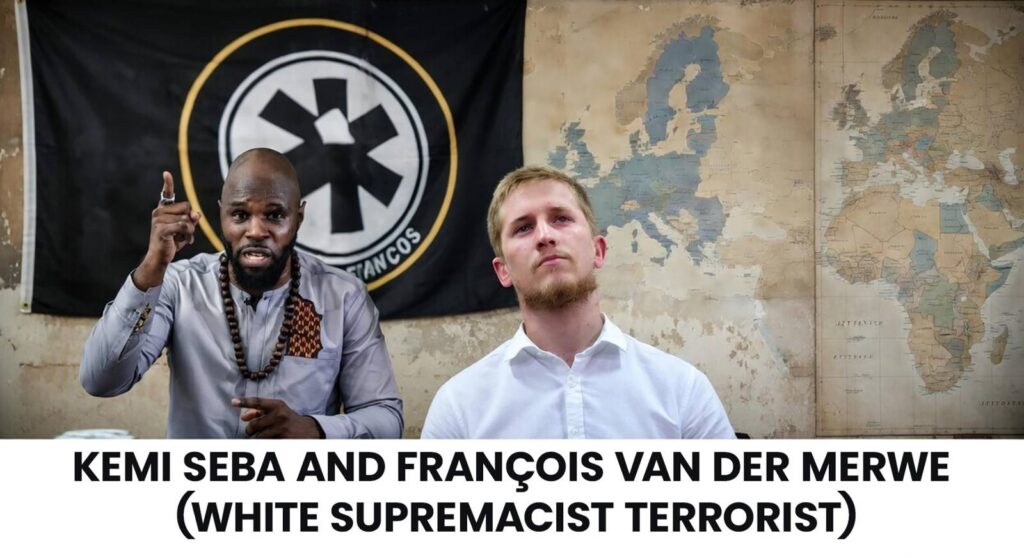
The detention of Kemi Seba on South African soil on Wednesday, April 15, was more than a simple police action; it was a moment of profound revelation. While the arrest itself made headlines, the true shock lies in the identity of the individual apprehended alongside him and the nature of their alleged financial transaction.
Accompanying the activist was François van der Merwe, a 26-year-old from Pretoria who serves as the head of the Bittereinders. This organization is not merely a political movement; it has been formally classified as a terrorist entity by South African authorities. To grasp the gravity of this alliance, one must look at the origins and extreme objectives of Van der Merwe’s group.
The ideology of the Bittereinders
The name Bittereinders refers back to the final, uncompromising phase of the Second Boer War. During that conflict, a faction of Boer guerrillas refused to accept defeat or negotiate with the British, viewing any form of surrender as a betrayal of their race and civilization. Van der Merwe has intentionally revived this name to signal a continuation of that radical legacy.
The modern incarnation of the group emerged following the murder of Brendan Horner and the subsequent unrest in Senekal. Van der Merwe, then in his early twenties, sought to mobilize young Afrikaners around a singular, alarmist conviction: that the presence of Black South Africans in positions of political power constitutes a terminal threat to Afrikaner culture. Their ultimate goal is the establishment of a Volkstaat—a racially exclusive, sovereign state carved out of South Africa where Black citizens would be entirely excluded from participation.
A history of radicalism and violence
Since its founding in 2021, the movement has been a disruptive force, staging aggressive protests against the ANC and the EFF. Van der Merwe rejects the post-1994 democratic transition, describing the current constitutional order as an “occupation.” He views policies aimed at Black economic empowerment not as restorative justice, but as a campaign of discrimination against white people.
The State Security Agency has kept a close watch on the Bittereinders due to their paramilitary activities. The group frequently conducts tactical training and self-defense drills at security academies, often filming and sharing these sessions as a show of force. Van der Merwe’s personal legal record is equally volatile; he was previously arrested for assault in late 2023 and again in early 2024 for breaching police lines and attacking an officer during a protest in Groblersdal. Despite these legal troubles, he has remained defiant, often quoting the Afrikaner phrase “Soet is die Stryd” (Sweet is the Struggle).
The financial connection and legal fallout
It is this radical figure that Kemi Seba reportedly sought out for assistance. According to the Hawks, South Africa’s elite organized crime unit, Seba allegedly paid Van der Merwe approximately 250,000 rands (over 13,000 euros). This significant sum was reportedly intended to secure an illegal passage for Seba and his son across the Limpopo River into Zimbabwe, with the ultimate goal of reaching Europe.
Under South African counter-terrorism laws, providing funds to a leader of a designated terrorist organization is a major criminal offense, regardless of the intent behind the payment. By handing over this money, Seba has moved beyond mere association into the realm of criminal financing.
A narrative in ruins
For years, Kemi Seba has cultivated a public persona as a defender of Black dignity and a critic of Western imperialism. He built a significant following across francophone Africa by preaching sovereignty and resisting white supremacy. However, his alleged financial support for a man who advocates for a return to Apartheid-style segregation creates a massive contradiction.
The charges Seba now faces—including illegal immigration, conspiracy, and the potential financing of terrorism—threaten more than just his freedom. They represent the total collapse of the political narrative he spent a career building. By allegedly funding a movement that views Black democratic rights as an historical error, Seba has alienated the very cause he claimed to represent.