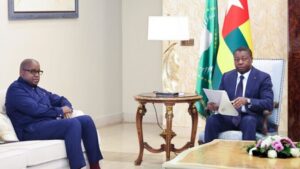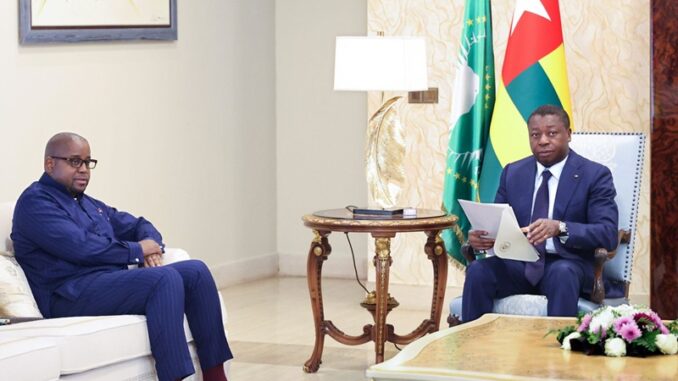
The Togolese Head of State, Faure Essozimna Gnassingbé, received today in Lomé the Minister of Regional Integration of the Democratic Republic of the Congo (DRC), Floribert Anzuluni, carrying a written message from President Félix-Antoine Tshisekedi Tshilombo.
During the meeting, Anzuluni confirmed that the Congolese delegation had been dispatched to formally hand Gnassingbé a direct appeal from Tshisekedi regarding the peace process in eastern DRC—where Gnassingbé serves as the African Union (AU) mediator.
What does this new written communication mean? Beyond diplomacy, it signals a renewed push by Kinshasa to accelerate the implementation of demobilization and reintegration initiatives aimed at tackling the ongoing armed group conflicts that have destabilized the region since 2021. The move underscores Tshisekedi’s insistence on a structured, time-bound roadmap under the AU-led framework, which Gnassingbé has spearheaded since assuming mediation duties in April 2025.
The timing is critical: despite existing diplomatic efforts including the Doha and Washington peace processes, eastern DRC remains plagued by persistent violence. Local populations continue to bear the brunt of insecurity, while regional stability hangs in the balance. Gnassingbé’s mandate—focusing on securing a durable ceasefire and long-term stabilization of the Great Lakes region—now faces intensified scrutiny as Kinshasa escalates its engagement.
Key objectives of the latest Congolese overture
Floribert Anzuluni outlined several priorities during the audience:
- Demobilization acceleration: Fast-tracking the surrender and disarmament of rebel factions to pave the way for sustainable peace.
- Peace consolidation framework: Strengthening institutional mechanisms to prevent the resurgence of armed groups and ensure community-level reconciliation.
- Regional cooperation: Enhancing cross-border security coordination with neighboring countries to disrupt supply chains of armed groups operating in eastern DRC.
Why this message matters now
The latest letter reflects a strategic pivot by Kinshasa. While diplomatic initiatives like Doha and Washington have yielded limited results, Tshisekedi appears to be doubling down on the AU-led mediation—now led by Gnassingbé—as the most viable path to tangible outcomes. The emphasis on demobilization and regional coordination suggests a recognition that military solutions alone are insufficient without political and economic reintegration.
For Gnassingbé, the Congolese message presents both a challenge and an opportunity: to translate diplomacy into concrete actions on the ground, particularly in securing ceasefires and preventing the resurgence of violence in mineral-rich territories.
Implications for eastern DRC and beyond
The push for a durable peace in eastern DRC carries regional implications. A stabilized eastern DRC could:
- Reduce cross-border spillovers: Limiting the movement of armed groups into neighboring countries such as Rwanda, Uganda, and Burundi.
- Revitalize economic corridors: Enabling the resumption of trade and infrastructure projects critical to the Great Lakes region’s recovery.
- Restore civilian trust: Rebuilding confidence in state institutions and international mediation efforts among local communities.
As Kinshasa intensifies its diplomatic engagement, the success of Gnassingbé’s mediation will depend largely on the implementation of the commitments outlined in Tshisekedi’s latest message—especially around demobilization and long-term stabilization. With civilians continuing to face displacement and violence, the urgency of delivering on these promises has never been greater.