Historic call for unity: President Tshisekedi launches inclusive national dialogue
In a landmark move to foster national cohesion, President Félix Tshisekedi has announced the launch of an inclusive national dialogue aimed at strengthening the country’s unity and addressing pressing challenges. The initiative follows a pivotal meeting with leaders from the nation’s major religious denominations at the Cité de l’Union africaine in Kinshasa.
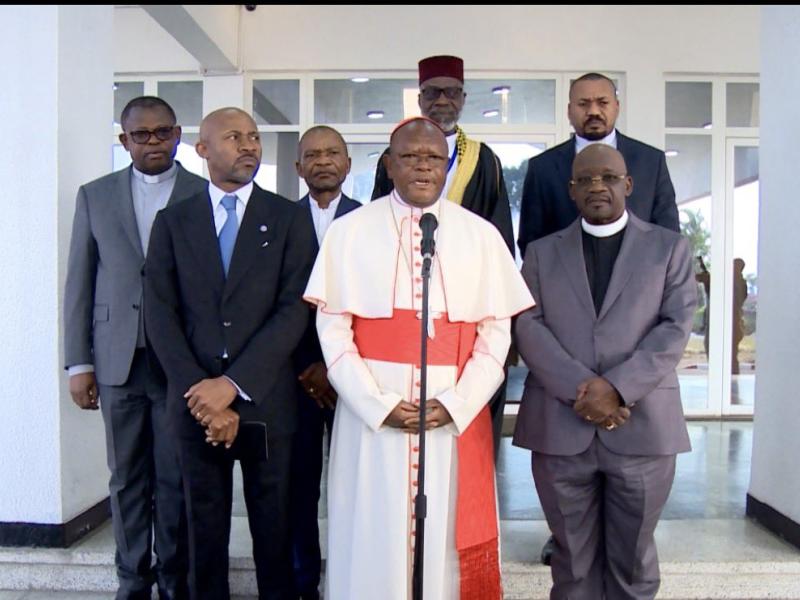
The presidential communiqué emphasized that the dialogue will be conducted in a spirit of republicanism and constitutional respect, with the goal of consolidating national cohesion. Cardinal Fridolin Ambongo, Archbishop of Kinshasa and spokesperson for the religious delegation, expressed enthusiasm for the initiative, stating, “We welcome this announcement and extend our gratitude to the Head of State.”
The cardinal highlighted that the dialogue represents a significant step toward achieving peace and unity, particularly in light of the ongoing conflict in the eastern regions of the country, which he attributed to external interference. “Our nation requires communion among all its sons and daughters,” he asserted, underscoring the urgency of national unity to address the crisis.
The religious leaders, representing a broad spectrum of faiths, have been entrusted with a critical role in facilitating this process. “We commit to advancing this initiative as a mission of faith,” Ambongo declared, urging both the ruling power and opposition to engage constructively in the dialogue.
The delegation included prominent figures such as:
- Bishop André Bokundoa, representing the Église du Christ au Congo;
- Archbishop Ejiba Yamampia, of the Église de Réveil du Congo;
- Sheikh Abdallah Mangala, from the Muslim Community;
- Bishop Donatien Nshole, spokesperson for the Catholic Church;
- Pastor Éric Senga, spokesperson for the Église du Christ au Congo.
The announcement comes amid heightened regional diplomatic activity, including consultations in Bujumbura and Brazzaville, where regional leaders have called for flexibility and dialogue to resolve the political and security crisis in the DRC.
While the details of the dialogue—such as its format, participants, agenda, and guarantees for all parties—remain to be finalized, the initiative marks a significant effort to bridge political divides. Opposition groups have previously demanded the release of political prisoners, the cessation of politically motivated prosecutions, and the restoration of public freedoms as prerequisites for meaningful discussions.
Earlier this month, President Tshisekedi reaffirmed his openness to dialogue but cautioned that it must not undermine the country’s institutions or the constitutional will of the people. The road ahead is complex, but the commitment to an inclusive process signals a potential turning point for the nation.