For more than two years, Burkina Faso’s authorities have stepped up hostile rhetoric toward France. Under Captain Ibrahim Traoré’s leadership, Paris is regularly portrayed as the symbol of a colonial past that the country aims to definitively shed. The expulsion of French forces, denunciations of Western influence, and a visible shift toward Russia and Iran have made the break a cornerstone of the government’s communication strategy.
Yet, beneath this confrontational stance, certain facts raise questions.
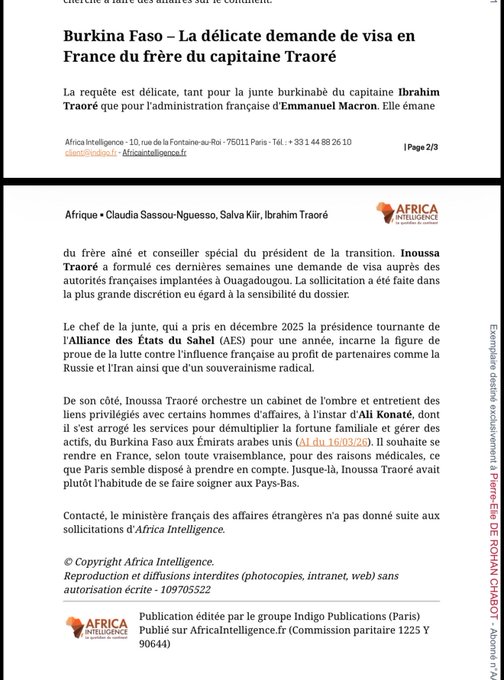
A document indicates that Ibrahim Traoré’s older brother, Inoussa Traoré, recently submitted a visa application to French authorities in Ouagadougou, handled with extreme discretion due to the sensitivity of the matter. Inoussa, described as a special advisor to the transitional president, reportedly seeks to travel to France for medical reasons. Previously, he received treatment in the Netherlands. The French Ministry of Foreign Affairs has not confirmed this information.
If true, this reveals a paradox difficult to ignore.
Since taking power, Ibrahim Traoré has built his political image on open opposition to France. Official speeches regularly condemn Paris, accusing it of various ills, while authorities call for severing ties with former Western powers.
In this context, a close family member seeking a French visa raises a political question: why try to enter a country portrayed as a strategic adversary if it is constantly denounced in official statements?
This situation provides ammunition to regime critics who have long pointed out a gap between political messaging and the personal choices of certain leaders.
The government in Ouagadougou claims full sovereignty and insists it has turned the page on dependence on France.
However, the reality of medical, financial, or administrative needs shows that international relations go beyond political slogans. Many African officials continue to travel to Europe for specialized healthcare, business, or personal matters, despite often critical official discourse.
In the Traoré family’s case, this visa request, if confirmed, risks fueling accusations of double standards: a tough public stance while France remains a partner turned to when circumstances demand.
This affair highlights that in politics, actions are often scrutinized as closely as words.
When a state is presented as an enemy or undesirable partner, any private approach toward that same country can be seen as a contradiction. While not alone proving political inconsistency, it inevitably fuels debate on the credibility of the sovereignty discourse promoted by Ouagadougou’s authorities.
Ultimately, if officially confirmed, this information would illustrate the limits of a policy based on a stated break with Paris, while showing that personal or institutional realities can sometimes lead to seeking services from the publicly criticized country.