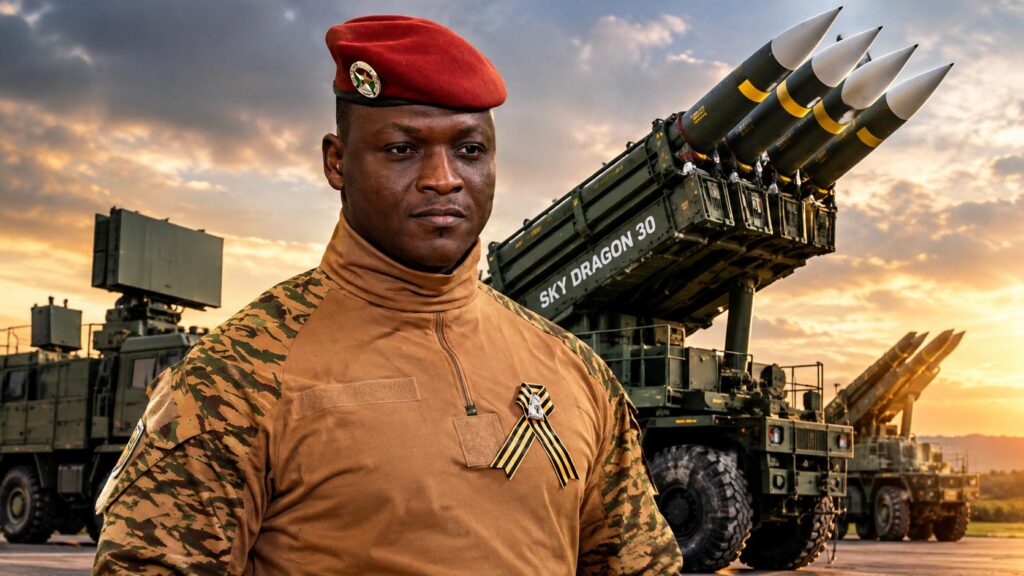
The staging was meticulously managed by the transitional government’s communication services: high-definition cameras, close-ups of gleaming armored vehicles, and martial speeches about the “rise to power” of the national armed forces. Yet behind the parade images and the storytelling of an invincible army, the exhibition of Captain Ibrahim Traoré’s latest military acquisition, the Chinese Sky Dragon 30 air-defense system, borders on strategic absurdity. In a country where villages are emptying under assaults by men on motorcycles, spending millions of dollars to intercept targets in the clouds amounts to an irresponsible political mystification.
The features of a high-tech monster that misses the point
Designed by the Chinese state-owned giant NORINCO, the Sky Dragon 30 (DK-10A) is anything but a counter-insurgency tool. A technical analysis of its specifications is enough to demonstrate the absurdity of this purchase:
- Its exclusive target: This is a medium-range surface-to-air missile system, designed exclusively to lock onto and destroy conventional aircraft: fighter-bombers, combat helicopters, large attack drones, or cruise missiles.
- Its range and altitude: The system is equipped with radar-guided missiles capable of downing targets flying up to 18,000 meters and within a 30-kilometer radius.
- Its radar infrastructure: It operates using a 3D search and track radar (IBIS 80) capable of detecting aircraft at over 130 km.
Faced with this deployment of high military technology, a commonsense question arises: what air threat is the regime trying to neutralize?
Shooting an anti-aircraft cannon at motorcycle-borne terrorists
The armed terrorist groups (GAT) that are bleeding Burkina Faso dry, besieging towns like Djibo, or forcing the inhabitants of Boussouma to flee, possess no aircraft, no helicopters, and no cruise missiles. The threat hanging over rural populations is exclusively ground-based, mobile, and asymmetric: groups of fighters moving in columns of motorcycles, ambushing from the bush, planting improvised explosive devices (IEDs) along dirt roads, or infiltrating villages at night.
A Sky Dragon 30 missile is rigorously incapable of detecting, targeting, or stopping a column of three men on motorcycles hidden under the vegetation cover of the Sahel. Better yet: using an aerial interception radar against a ground threat is like trying to stop a swarm of wasps with a whale net.
The spectacle of power to mask failure on the ground
If this equipment is militarily useless against Burkina Faso’s real security challenge, why was it purchased? The answer lies in the transitional regime’s communication strategy. To maintain the illusion of “recovered sovereignty” and mask the state’s continuous territorial retreat on the ground, the military power needs imposing visual symbols.
A surface-to-air missile mounted on an armored truck makes magnificent images for national television and social media. It fuels the myth of an army modernizing at great expense and leads the public to believe that an “invisible external enemy” is lurking, thus justifying security paranoia and the locking down of political debate.
While millions of dollars leave public coffers to pay for Chinese technological toys incapable of firing on a single terrorist, soldiers on the front lines lack basic demining equipment, contact intelligence, and fuel to secure roadways. The acquisition of the Sky Dragon 30 is not a military victory: it is an admission of strategic blindness and a costly propaganda operation paid at a high price by the Burkinabè people.