In Ouagadougou, the contrast is stark—almost grotesque. On one side, a government clinging to rhetoric of “reclaimed sovereignty” and unyielding resistance to grassroots solidarity. On the other, a humiliating dependence on foreign aid to feed its own people. By banning local initiatives and NGOs from assisting the most vulnerable Burkinabè under the guise of regulating humanitarian aid, the Traoré administration has taken a step that is as cruel as it is politically calculated. Yet the irony deepens when, in the very same breath, authorities in the capital turn to Moscow, cap in hand, for shipments of wheat to avert famine.
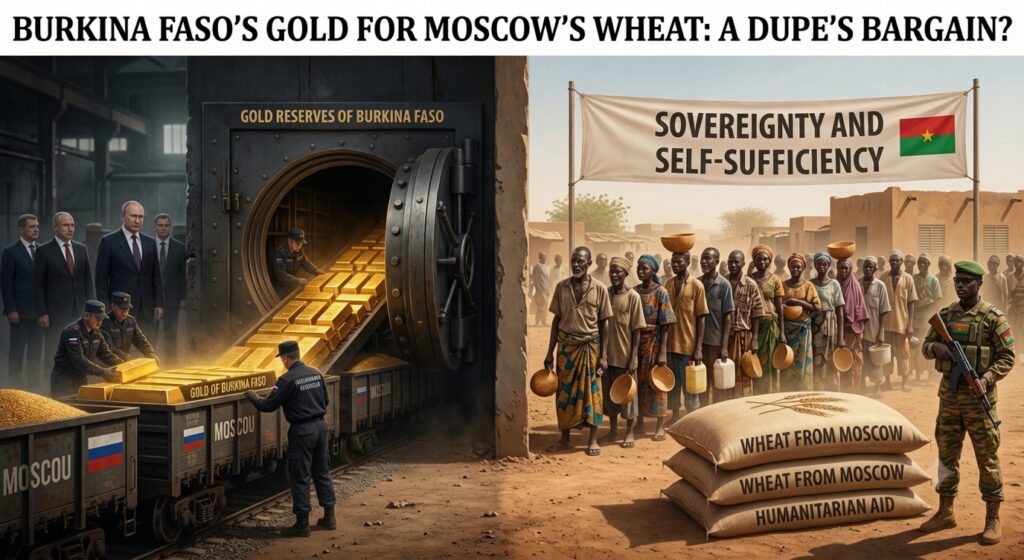
The recent visit of Russia’s foreign minister laid bare the mechanics of this lopsided “cooperation.” With the finesse of a seasoned diplomat, the Kremlin envoy hailed Burkina Faso’s decision to transfer and store its national gold reserves at the Bank of Moscow. An announcement that reads less like a sovereign financial strategy and more like a surrender of economic autonomy. For a regime that built its legitimacy on breaking with neocolonialism and vowing absolute independence, entrusting the nation’s gold to Moscow smacks of a Faustian bargain.
The inconsistency is glaring. Months of official discourse have championed self-sufficiency and economic sovereignty, yet the most basic nutritional needs remain unmet without external intervention. A sovereignty that hinges on imported grain shipments is a hollow victory—one that neither secures food supplies nor guarantees the welfare of citizens. True autonomy is measured not by defiant rhetoric but by the ability to protect and nourish a population year after year.
The arithmetic of this partnership is brutally simple: Burkina Faso is pledging its sovereign wealth—its gold—to secure security assurances and, above all, emergency food aid. Receiving Russian wheat to feed a population ravaged by conflict is no geopolitical triumph; it is the emblem of failure. How can a nation claim pride when its survival depends on the goodwill of a foreign patron, to whom it has handed the keys to its most prized treasure?
Beyond symbolism, this arrangement raises pressing questions about national priorities. Burkina Faso ranks among West Africa’s top gold producers—a resource that should, in theory, fund agricultural policies, storage infrastructure, irrigation systems, and sustainable support for local producers. Yet as the country continues to rely on foreign food aid, observers are increasingly questioning how national wealth is being allocated and whether it is truly improving lives.
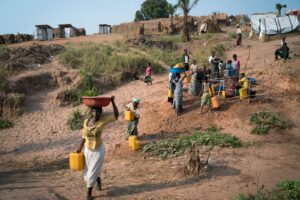
The most galling dimension of this crisis is the government’s internal mismanagement of suffering. While it is undeniable that feeding a population amid asymmetric warfare presents enormous challenges, actively undermining national solidarity by restricting or criminalizing mutual aid is a calculated move toward total social control. By monopolizing aid distribution, the Traoré regime appears determined to ensure that every bag of rice or wheat reaching a hungry citizen is seen not as an act of human solidarity, but as a gift from the state—reinforcing dependence and loyalty.
This centralization of assistance carries grave political risks. In crisis settings, humanitarian organizations, local associations, and citizen-led initiatives often operate where state presence is weak or non-existent, especially in areas plagued by insecurity. Limiting their role not only slows the delivery of critical aid but also funnels vulnerable populations into state-controlled channels, fueling suspicions of political manipulation.
Another paradox emerges in the widening gap between public sacrifice and tangible outcomes. Citizens are repeatedly called upon to endure hardship in the name of national sovereignty, counterterrorism, and state rebuilding. Yet when insecurity persists, daily struggles deepen, and the country still begs for foreign food shipments to meet basic needs, the meaning of these sacrifices erodes. Sovereignty is not declared; it is proven through consistent protection and nourishment of the people.
While Burkina Faso’s gold flows eastward to underwrite political survival at the top, the people at the bottom are left with a mere illusion of independence—and a very real hunger. By substituting one overlord for another, the Traoré regime has not liberated the nation; it has merely traded one form of dependency for another, at a cost that grows heavier with each passing day.
The ultimate question is not which foreign partner Burkina Faso chooses, but whether such partnerships truly strengthen the country’s autonomy or merely postpone the reckoning. Sovereignty is not measured in defiant speeches or foreign alliances alone. It is proven in the daily reality of its citizens—secure, fed, dignified, and free.