The definition of a coup d’état frequently shifts, influenced by the geopolitical interests and perceived goodwill of the international community and its regional allies. In Burkina Faso, the appointment of Transitional President Michel Kafando was widely considered unconstitutional. For a projected twelve-month period, the nation was set to operate under institutions meticulously constructed for this interim phase.
Like pieces of a complex puzzle, the transitional institutions gradually took shape. Following the dramatic entry of military personnel onto the public stage, in the wake of former President Blaise Compaoré’s swift departure from Kosyam, Ouagadougou began to experience a fragile sense of calm.
Emerging seemingly from obscurity, Lieutenant-Colonel Isaac Zida rapidly filled the power vacuum, assuming many of the prerogatives typically held by a head of state. His true intentions were a subject of intense speculation. How did he manage to integrate himself among the protesting citizens and political party leaders? Was his deployment to the Place de la Révolution, perhaps, a calculated move orchestrated in concert with President Compaoré and General Gilbert Diendéré, aimed at maintaining some form of control over the reins of power? Initially, an officer from the Presidential Security Regiment (RSP) aligning with the popular movement raised immediate suspicions and distrust. The military’s actions and initial decrees, including the suspension of the Constitution and dissolution of the National Assembly, fueled fears of an impending junta. This threatened to strip the people, who had sacrificed and shed blood, of their hard-won victory.
True to form, the African Union promptly threatened sanctions against Burkina Faso. Concurrently, heads of state from ECOWAS – including John Dramani Mahama of Ghana, Goodluck Jonathan of Nigeria, and Macky Sall of Senegal – arrived en masse to engage with the military leadership, urging them to reconsider their stance. The precedents set by previous military takeovers, such as those involving Captains Daddis Camara in Guinea and Sanogo in Mali, undoubtedly compelled Burkinabé officers to exercise caution. It became clear that seizing power by force would no longer go unpunished, and a protracted resolution to the crisis risked isolating the country and fostering widespread unpopularity.
Consequently, the army eventually negotiated a compromise solution, formally outlined in the Transition Charter. The agreement stipulated that the Executive branch would be led by a civilian transitional president, while the military would retain significant influence over the government. A legislative body comprising 90 members, the National Transitional Council (CNT), was established to accommodate key figures who had spearheaded the struggle. A Designation Committee, composed of approximately twenty members, was tasked with the crucial responsibility of naming a Transitional President. This was a fixed-term mandate, set to conclude in November 2015, coinciding with the end of President Blaise Compaoré’s original term.
For the selection of the head of state, each major national stakeholder – the army, civil society, opposition parties, and religious and traditional authorities – was required to submit a shortlist within a specified timeframe. Ultimately, five individuals were chosen for consideration:
The opposition and civil society put forward two prominent journalists: Newton Ahmed Barry, director of the weekly L’Événement, and Chériff Sy Moumina, publishing director of the weekly Bendré. Their legitimacy stemmed from their media outlets’ consistent criticism of the former regime. The military adopted a broader approach, diversifying its candidate profiles: an ecclesiastical figure, Archbishop Mgr Ouédraogo of Bobo Dioulasso; a diplomat, Michel Kafando; and a woman, former minister Joséphine Ouédraogo. Early on, Archbishop Ouédraogo, initially a strong contender, declared his disinterest in the role, preferring to focus on his current ministry.
The remaining two candidates held a distinct advantage due to their extensive experience within major international institutions. Ms. Joséphine Ouédraogo had previously served with the United Nations Economic Commission for Africa (UNECA), while Michel Kafando had twice represented Burkina Faso at the UN Headquarters in New York, first from 1981 to 1982 and again from 1998 to 2011. In the nation known as the ‘Land of the Upright Man,’ an unspoken divide often separates individuals into those ‘for’ or ‘against’ Thomas Sankara. This implicit ideological cleavage has historically shaped the political trajectory of many public figures. Joséphine Ouédraogo served as Minister of Family Development and Solidarity between 1984 and 1987. Michel Kafando, conversely, was Minister of Foreign Affairs in Thomas Sankara’s government, under President Jean-Baptiste Ouedraogo in 1982. The two reportedly had disagreements regarding the conduct of Upper Volta’s diplomacy and held diametrically opposed ideological views.
A career in an international institution offered a dual benefit: a significant boost to one’s curriculum vitae and an invaluable network of contacts. This proved to be a disadvantage for the two aspiring journalists put forward by the opposition.
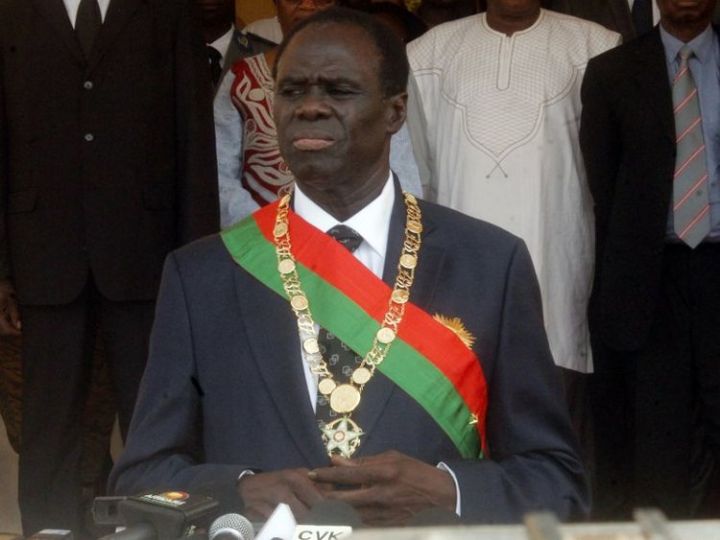
For a limited period, Michel Kafando, the retired diplomat, was compelled to set aside his cattle and chicken farming endeavors in Saponé for a higher calling: to safeguard the nation in crisis! He assumed the dual responsibilities of Transitional President and Minister of Foreign Affairs. This dual role streamlined diplomatic channels, providing international partners with a single interlocutor and effectively sidestepping the head of government, Isaac Zida.
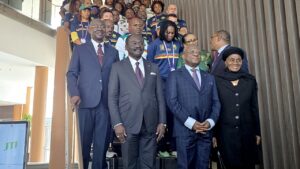
The evolving situation in Burkina Faso was closely monitored from various capitals: Accra, which currently chairs ECOWAS; Addis Ababa for the African Union; and Paris and Washington for their significant geopolitical interests. On the day of Michel Kafando’s investiture, several heads of state – from Mauritania (African Union), Ghana (ECOWAS), Togo, Benin, Mali, and Niger – attended, symbolizing a collective effort to reintegrate Burkina Faso. Did this robust representation implicitly endorse the reinstatement of a constitution that had been suspended just weeks prior? The United States typically adheres to a principle of non-cooperation with heads of state not chosen through universal suffrage, which was the case in Burkina Faso. However, the international community ultimately found a way to legitimize the coup’s outcome and establish a constitutional semblance. This ensured American reconnaissance aircraft could remain stationed in Ouagadougou, as Uncle Sam relies on Mauritania and Burkina Faso as crucial bases for monitoring the Sahel region.
Out of 26 ministerial portfolios, the military secured four key positions: the Prime Minister also held the Ministry of Defense; Colonel Auguste Denise Barry, a former Security Minister in 2011, was assigned the Ministry of Territorial Administration, Decentralization, and Security (MATDS); Colonel David Kabré, spokesperson for Lieutenant-Colonel Isaac Zida, took charge of Sports; and Boubacar Ba assumed leadership of the highly strategic Ministry of Mines and Energy. Joséphine Ouédraogo was appointed Keeper of the Seals – a form of consolation prize – while Augustin Loada, a university professor and prominent civil society figure, was named to the Public Service. Adama Sagnon, who inherited the Ministry of Culture, resigned just days after his appointment due under pressure from civil society, which criticized him for having previously ‘closed’ the Norbert Zongo case.
The National Transitional Council (CNT), the interim legislative body, elected Chériff Sy Moumina, one of the unsuccessful candidates for the transitional presidency, as its president. He was chosen by his peers with 71 out of 90 votes. The next critical steps involve completing the institutional framework and mechanisms necessary to guide Burkina Faso towards transparent and equitable elections, including establishing the National Independent Electoral Commission (CENI), drafting a new electoral code, and implementing organic laws.
What missions define this brief transitional period?
Since early December, Michel Kafando signed the presidential decree establishing the National Reconciliation and Reforms Commission (CRNR). The scope and duration of this body’s mandate remain crucial questions. More than 27 years after the assassination of Thomas Sankara, the ‘Land of the Upright Man’ finally sought to embark on a process of catharsis. Shortly after his designation, one of President Michel Kafando’s initial decisions was to authorize investigations to identify Thomas Sankara’s remains. Prime Minister Isaac Zida also played a role, announcing that the file on President Thomas Sankara’s assassination would be ‘fully opened,’ and that Burkina Faso would, if necessary, seek ‘extradition’ of former president Blaise Compaoré from Morocco.
Through a series of high-profile announcements, the current leaders effectively opened a Pandora’s Box. Such complex cases demand considerable time, likely extending beyond the transitional period. Were these declarations made to reassure opponents of the Blaise Compaoré regime? As Minister of Defense, army reform should have been Isaac Zida’s priority. In this context, General Gilbert Diendéré – Blaise Compaoré’s chief of staff and Isaac Zida’s direct superior – was relieved of his duties by President Michel Kafando. He was replaced by Commander Théophile Nikièma, former head of the RSP’s ‘Operations and Instruction’ Bureau and also director of External Documentation, essentially the intelligence service of the Kosyam palace.
The question of loyalty between Lieutenant-Colonel Isaac Zida, Commander Théophile Nikièma, and General Gilbert Diendéré remains. Burkina Faso managed to defuse the political crisis of October 30th, which led to Blaise Compaoré’s downfall, with relatively few major incidents. The intervention of RSP elements during the initial skirmishes could have easily triggered a civil war. Would it not be more prudent to prioritize the organization of elections rather than implicate General Gilbert Diendéré and other living civilian and military figures by re-opening the Sankara case?
How can a ‘witch hunt’ be avoided? Already, two general managers of major national enterprises, perceived as close to the ousted president’s family, have been dismissed: Jean-Baptiste Bérehoundougou from the Société Nationale Burkinabè des Hydrocarbures (SONABHY) and Jean Christophe Ilboudo from the Société Nationale Burkinabè d’Électricité (SONABEL). While an act of contrition does not fully absolve past transgressions, it contributes to reconciliation; this was the recent approach taken by Gilbert Noël Ouédraogo of the Alliance for Democracy and Federation – African Democratic Rally (ADF-RDA), a political party affiliated with the former presidential movement. Similarly, the nation paid homage to the seven individuals who died during the events of October 30th and 31st, now laid to rest in the Gounghin cemetery.
Will the CRNR endure beyond the end of the transitional period? With all institutions now in place, political figures and parties are poised to take center stage. No prominent political leader sought a seat in either the Executive or the CNT, which effectively disqualifies them from running in future general elections. Presidential candidates are already preparing for the race. The formation of the CNT also marked the occasion for the CFOP, the opposition coalition, to dissolve itself. The electoral battle is expected to intensify from early 2015.