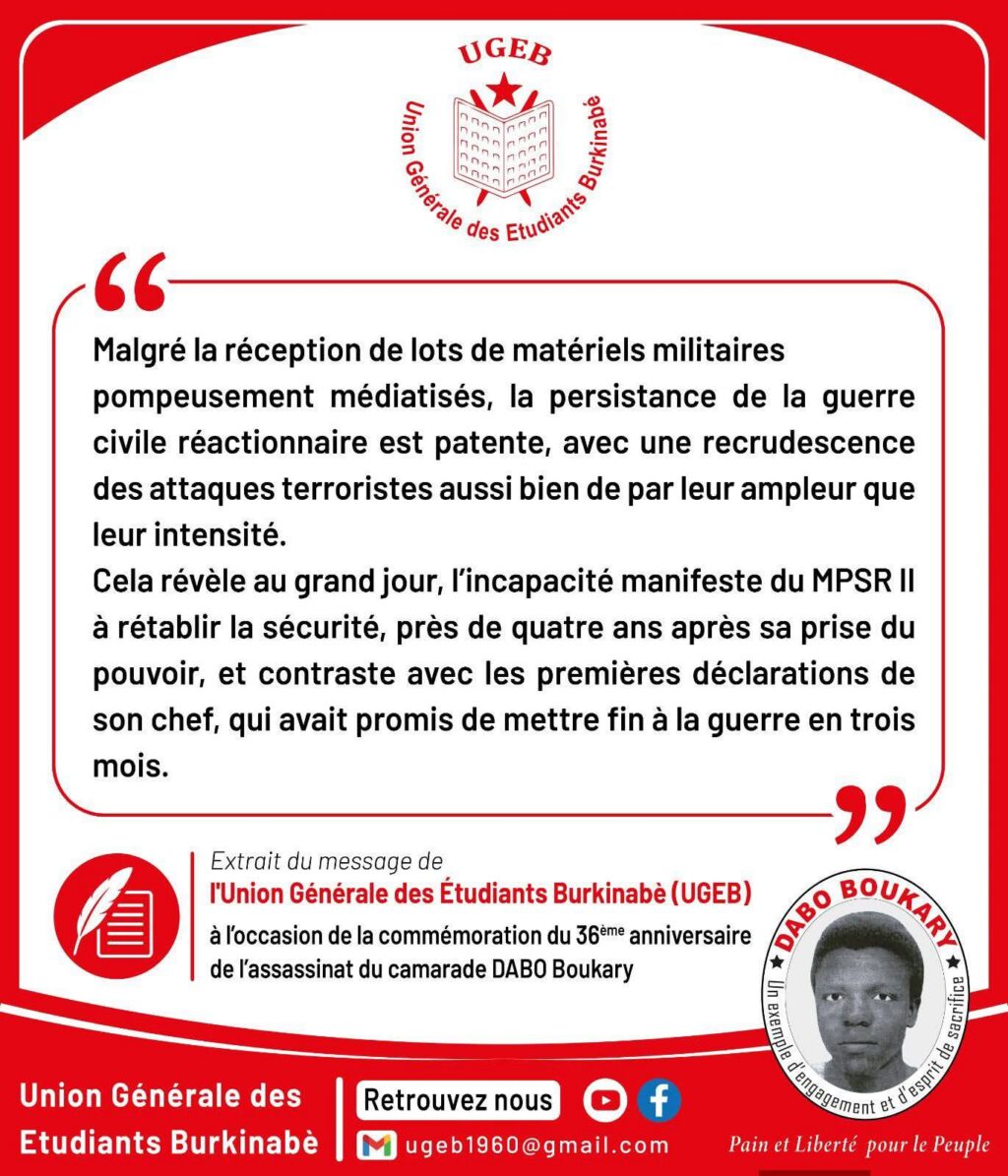
The security landscape in Burkina Faso remains dire nearly four years after the Movement for Patriotism and National Restoration (MPSR II) assumed control. In an official statement obtained by our team, the General Union of Burkinabe Students (UGEB) has delivered a scathing assessment of the transition led by Captain Ibrahim Traoré. Amid relentless attacks, a severe humanitarian crisis, skyrocketing living costs, and unfulfilled pledges, the student organization has highlighted the stark limitations of the current government’s approach in Ouagadougou.
From hopeful beginnings to a bleak reality
When Captain Ibrahim Traoré seized power in September 2022, his ascent was met with cautious optimism among a war-weary population. The young leader hinted at a swift resolution to the security crisis, suggesting a three-month timeline to reverse the tide. Yet, as the clock struck forty-eight months, the UGEB’s verdict is unambiguous: the results have fallen far short of expectations.
The syndicate reminds authorities of their initial commitments, starkly contrasting them with the harsh realities on the ground. Far from abating, armed group attacks have surged in both frequency and ferocity. The once-flickering hope for a quick victory has now faded, replaced by a conflict that shows no signs of waning, leaving a frustrated public demanding tangible progress.
Military posturing vs. ground-level struggles
For the student movement, the disconnect between official narratives and the lived experiences of ordinary Burkinabè is glaring. Recent months have seen state media spotlight the arrival of advanced military hardware—drones, fighter jets, armored vehicles, and heavy weaponry—presented as symbols of progress. The UGEB dismisses this as mere “showcasing,” arguing that such displays do little to address the persistent insecurity gripping vast swathes of the country.
The syndicate points out that while military communications boast of enemy losses, the daily lives of citizens remain ensnared in fear. The relentless insurgent incursions continue to paralyze communities, underscoring that hardware alone cannot substitute for a cohesive, effective strategy on the ground.
A humanitarian and economic collapse
The failure to restore security has triggered cascading crises across Burkina Faso’s social and economic fabric. Mass displacement remains one of the most visible scars of the conflict, with millions forced to abandon their villages for the relative safety of urban centers. In their exodus, they leave behind livelihoods—fields, crops, and homes—now left to decay under the shadow of conflict.
This humanitarian disaster is compounded by an economic freefall. Inflation has tightened its grip on households, with students—represented by the UGEB—bearing the brunt of soaring prices for essential goods. Remote regions, cut off by armed group blockades, face acute shortages, driving up the cost of staples like food and fuel. Purchasing power has plummeted, leaving a population already battered by war even more vulnerable.
New military alliances: a gamble with no payoff yet
Under the MPSR II transition, Burkina Faso has dramatically realigned its military partnerships, severing long-standing defense ties—particularly with former allies—and pivoting toward new ones, most notably Russia and the Alliance of Sahel States (AES).
The UGEB scrutinizes this strategic pivot, questioning its effectiveness. Despite the arrival of foreign trainers and support to bolster the Forces de Défense et de Sécurité (FDS) and the Volunteers for the Defense of the Homeland (VDP), peace remains elusive. The syndicate argues that these new alliances have yet to deliver the promised dividends, with sovereignty rhetoric failing to translate into tangible control over the nation’s territorial integrity.
A call for accountability and urgent action
The UGEB’s critique resonates as a stark warning in a political landscape marked by growing discontent. By exposing the chasm between rapid liberation promises and the unyielding violence, the organization underscores the urgent need for a candid reassessment of the MPSR II’s strategic choices.
For Burkina Faso, the stakes could not be higher. The time has come to move beyond war rhetoric and translate announcements into real, everyday security for every citizen. The humanitarian toll and economic strain demand nothing less.