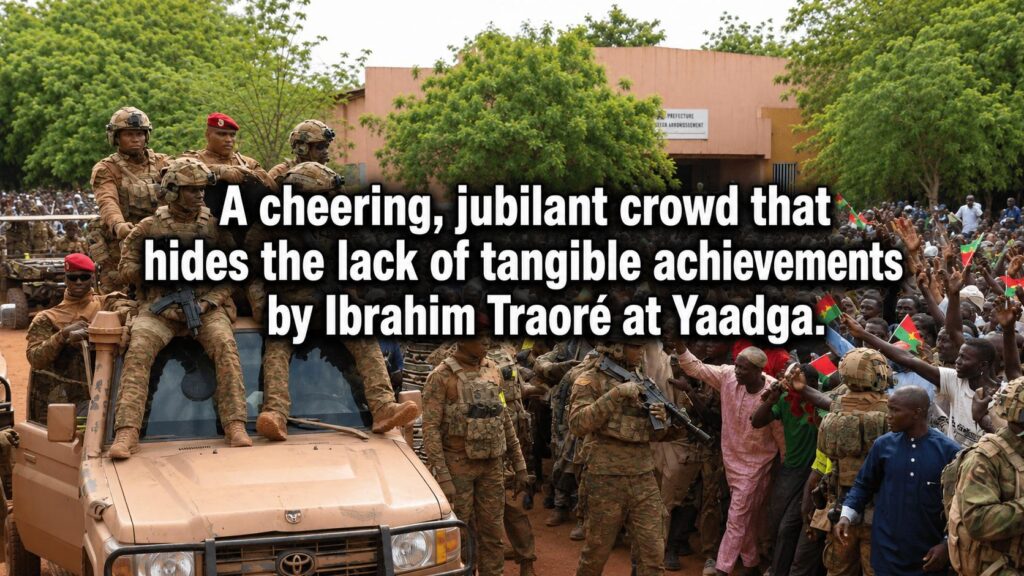
The recent public appearances of Captain Ibrahim Traoré in the Yaadga region were met with fervent popular enthusiasm, characterized by widespread jubilation upon his arrival and departure. While proponents of the Head of State interpret these gatherings as clear evidence of broad public support for his administration, evaluating a leader’s performance solely on the perceived popularity of their tours risks conflating political messaging with a comprehensive assessment of their actual achievements.
It is a common phenomenon in any nation for political figures to be greeted with zealous receptions during official engagements. Nevertheless, such visually striking displays, no matter how impressive, do not inherently serve as dependable metrics for the quality of governance. Instead, the true measure of an administration’s effectiveness lies in its public policies, the concrete results achieved, and the tangible improvements in the daily lives of its citizenry.
Critics of the current administration contend that Captain Ibrahim Traoré’s strategic approach heavily relies on populist communication. His public pronouncements frequently feature fervent patriotic rhetoric, historical allusions, and recurring criticisms directed at neighboring nations. This focus persists even as a significant portion of the Burkinabè populace anticipates substantive solutions to their everyday challenges. For these observers, such rhetorical emphasis appears designed to sustain emotional engagement rather than to present an authentic account of governmental progress.
Rather than dedicating substantial portions of his addresses to discussing sub-regional history or attributing the challenges facing Burkina Faso to external parties, detractors suggest that the Head of State would be more effective by channeling his efforts toward fulfilling the pledges made to the populace. Key areas of public expectation include enhanced security, robust economic revitalization, opportunities for youth employment, improved access to essential public services, and decisive action against widespread precarity.
According to these critical perspectives, the prevailing governance model appears more aligned with a policy of symbolic gestures than with one centered on tangible outcomes. While grand pronouncements regarding national sovereignty and dignity may resonate with a segment of the public, they ultimately cannot substitute for vital infrastructure, functional educational institutions, accessible healthcare facilities, employment opportunities, or the sustainable restoration of security in regions afflicted by violence.
This particular strategy is also frequently accused of fostering a form of political misdirection. When public discourse is steered towards discussions concerning international relations with neighboring states or historical narratives, there is an inherent risk that the immediate and pressing concerns of the Burkinabè population may recede into the background. Citizens are primarily seeking quantifiable solutions, not merely motivational speeches.
Consequently, the vivid scenes of popular enthusiasm disseminated across social media platforms should not be automatically construed as an unequivocal endorsement of the policies being implemented. Historical precedents consistently demonstrate that a leader’s popularity is often volatile and, in the long term, contingent upon their capacity to deliver concrete results, rather than solely on the ability to generate excitement during public appearances.
In summation, critical observers assert that Burkina Faso’s imperative need is for a governance framework rooted in demonstrable achievements, rather than one predominantly sustained by continuous communication. While rhetorical addresses, historical allusions, and public displays of support can undoubtedly cultivate a political image, they are no substitute for essential reforms, strategic investments, and the concrete answers demanded by a populace confronting significant challenges. For these analysts, so long as fundamental promises remain without visible manifestation in the daily existence of Burkinabè citizens, mere demonstrations of popularity will prove insufficient to obscure the persistence of unfulfilled expectations.