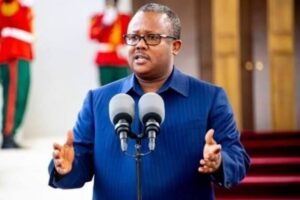
The Republic of Benin has ushered in a new era of governance with the unveiling of its first government under President Romuald Wadagni. Sworn in on May 25, 2026, Wadagni’s administration presents a compact team of 24 ministers, reflecting a deliberate strategy of continuity rather than radical change. This approach underscores his deep-rooted political lineage, having previously served as the long-time Minister of Economy and Finance under his predecessor, Patrice Talon.
Government mirrors talon-era stability
The roster of appointees reveals a striking resemblance to the outgoing administration. A significant number of former ministers have been retained, signaling President Wadagni’s commitment to maintaining Benin’s impressive macroeconomic trajectory since 2016. The nation boasts one of the strongest growth performances within the West African Economic and Monetary Union (UEMOA), a reputation built largely on the financial acumen Wadagni himself cultivated through international market strategies—a legacy he is keen to preserve.
The President’s technocratic background, shaped during his tenure at Deloitte, is evident in the cabinet’s composition. Key portfolios—including Economy, Infrastructure, and Digital Transformation—remain in the hands of individuals closely aligned with the previous administration. This continuity suggests that major initiatives launched under Talon, from the expansion of the Port of Cotonou to the development of Special Economic Zones and public service digitization, will proceed under familiar leadership.
Six women appointed, political exclusivity persists
Of the 24 ministerial positions, six are held by women, accounting for a quarter of the cabinet. While this figure aligns with regional averages in West Africa, it does not represent a groundbreaking shift. Notably, none of the female appointees have been assigned critical sovereignty-related ministries, which remain dominated by male figures from the President’s inner circle.
The most telling political decision lies elsewhere. Several opposition figures publicly endorsed Wadagni’s candidacy during the election, anticipating ministerial roles as a reward for their support. None, however, have been included in the final lineup. By excluding opposition voices, the President has opted to consolidate power within the ruling coalition, comprising the Bloc républicain and the Union progressiste le Renouveau. This move raises questions about the sincerity of his earlier pledges to foster broader political dialogue, particularly amid pre-election tensions over opposition participation.
Economic priorities take center stage while political negotiations stall
The swift announcement of the cabinet, finalized within hours of the inauguration, highlights meticulous pre-election planning. Wadagni’s choices were evidently finalized well in advance, allowing the administration to avoid the institutional uncertainty often seen during political transitions in West Africa. With a fully operational executive now in place, Benin can immediately address pressing issues, from maintaining its International Monetary Fund program to reinforcing security along its northern borders, where jihadist pressures from the Sahel loom large.
Yet the real test for this government lies beyond reassuring economic stakeholders. Social challenges—escalating living costs, youth unemployment, and civil society engagement—demand more than technical expertise. The absence of political outreach could prove costly in the coming months, especially as the ruling coalition gears up for upcoming local and legislative elections. The 2026 legislative calendar will serve as an early gauge of the administration’s ability—or willingness—to engage with a political landscape it has, thus far, chosen to exclude.