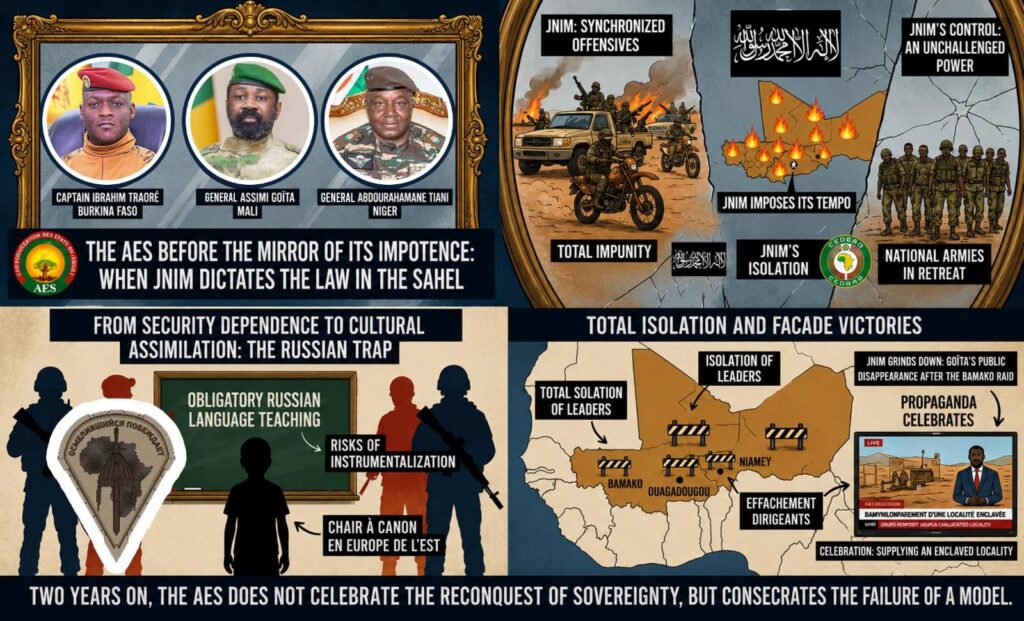
The Alliance of Sahel States (AES) is facing a harsh reality two years after its much-touted inception. Despite the fiery rhetoric of sovereignty and military juntas in Bamako, Ouagadougou, and Niamey, the battlefield tells a different story: the Group for the Support of Islam and Muslims (JNIM) remains the only force capable of orchestrating coordinated, high-impact offensives across the region.
The JNIM’s strategy has exposed the fragility of the AES’s approach. Coordinated strikes targeting multiple strategic zones simultaneously have repeatedly overwhelmed national armies, despite their advanced equipment. Neither the theoretical pooling of intelligence resources nor the full alignment with Moscow has succeeded in stemming the tide of JNIM’s advances.
From security dependency to cultural assimilation: the Russian trap
The AES’s response to this security vacuum has been a deepening partnership with Russia. But this alliance extends far beyond military cooperation or the presence of Wagner Group mercenaries—now rebranded as the Africa Corps. A recent decision to introduce Russian language instruction in Burkinabè schools starting next year signals a pivotal ideological shift. Marketed as a move toward cultural decolonization, this policy is, in fact, a calculated effort to reshape the psychological and structural foundations of Burkina Faso’s youth.
The implications of this linguistic shift are profound. By embedding Russian in the curriculum, the regime is laying the groundwork for a generation more deeply integrated into Moscow’s sphere of influence. The long-term risk is clear: these children, once sent to Russia under the guise of education or training, could be exploited as pawns in broader geopolitical conflicts. In a world already divided by global tensions, the fear is that Sahelian youth could become expendable assets—or worse, human shields—in conflicts far removed from their homeland, all to sustain Russia’s military support for the juntas.
A growing isolation and hollow victories
While the cultural transition unfolds, the JNIM continues to tighten its grip. By paralyzing the three regimes, the armed group has confined their leaders to a state of near-total isolation. In Mali, the prolonged absence of transitional leader Assimi Goïta from public view—following a deadly raid in Bamako that reportedly killed the Defense Minister—serves as a stark example of this erosion of control.
The bitter truth is undeniable: while the JNIM consolidates its territorial gains, military juntas are drowning in political absurdity. State propaganda now celebrates trivial achievements, such as the resupply of a remote outpost or a defensive counterattack, as major victories. This is the ultimate admission of failure.
At the two-year mark, the AES is not celebrating sovereignty regained but confronting the collapse of its own model. By conflating war propaganda with military strategy and swapping one dependency for another—from the West to Moscow—the juntas have allowed the JNIM to dictate the pace of conflict. The Sahel has not liberated itself; it has merely exchanged one set of masters for another, with its youth paying the highest price.