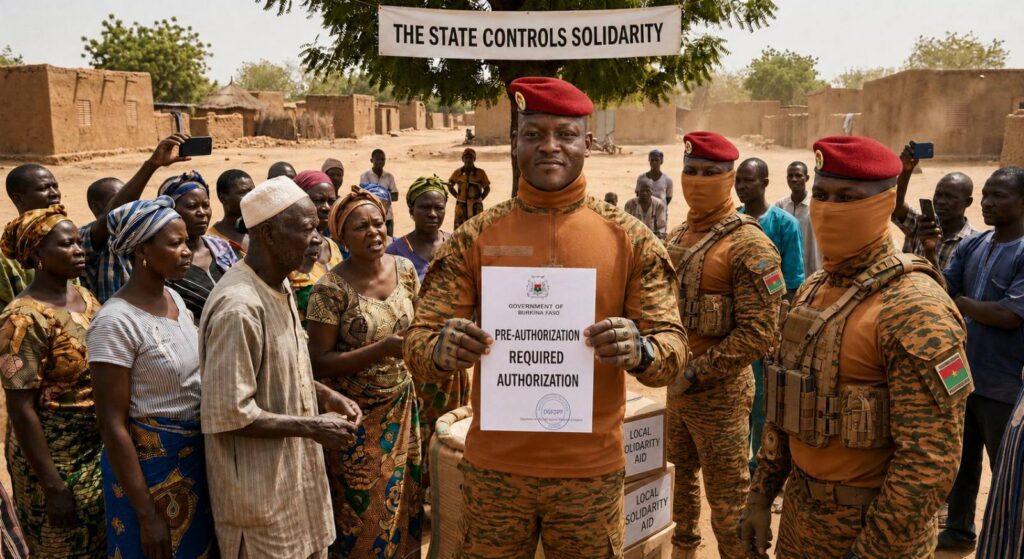
In Burkina Faso, a sweeping regulatory shift is redefining the landscape of charitable actions. The Ministry of Solidarity has introduced stringent measures requiring all forms of public assistance to obtain prior approval, or face severe penalties. While authorities frame this as a necessary step to uphold human dignity and prevent digital exploitation of suffering, the policy’s broader implications reveal a troubling erosion of civic freedoms.
from spontaneous generosity to administrative approval
The new directive eliminates the possibility of informal or decentralized charitable initiatives, particularly those that emerge organically in response to crises. Historically, Burkinabè communities, diaspora networks, religious groups, and local associations have been the first to respond to emergencies—often long before state mechanisms activate. By imposing a mandatory administrative visa for any act of solidarity, the government risks suffocating the very resilience that has sustained the nation through years of instability.
a climate of suspicion and bureaucratic overreach
The decision reflects a broader trend of state centralization, where even the most well-intentioned gestures are viewed through the lens of control. Under the leadership of Captain Ibrahim Traoré, the transitional government appears to perceive autonomous civic action as a challenge to its authority. This approach not only stifles grassroots solidarity but also fosters an atmosphere of distrust between citizens and public institutions.
Critics argue that while regulating online fundraising may address certain abuses, blanket restrictions on all charitable activity are disproportionate. The distinction between legitimate oversight and outright suppression of empathy is becoming increasingly blurred, with the state positioning itself as the sole arbiter of compassion.
the consequences of disconnecting policy from reality
One of the most alarming aspects of this policy is its disconnect from the urgent humanitarian needs on the ground. Burkina Faso continues to grapple with escalating security threats, mass displacements, and economic hardship. In such a context, delays caused by bureaucratic approval processes can have dire consequences. Medical emergencies, food shortages, and population displacements do not adhere to ministerial timelines.
The state’s inability to swiftly replace the void left by restricted civic initiatives raises serious questions. What happens to those in distress when the very networks meant to protect them are rendered inoperative by administrative red tape? The answer, unfortunately, is often abandonment.
the hidden cost of a misguided approach
Beyond immediate humanitarian risks, the policy may discourage future acts of generosity. Fearing penalties or protracted procedures, individuals and groups may hesitate to contribute, further weakening the social fabric. The concept of solidarité de brousse—the organic, community-driven bonds that have sustained Burkina Faso—risks being replaced by a rigid, state-controlled model of assistance.
The government’s narrative of preserving dignity by restricting public displays of suffering is fundamentally flawed. True dignity lies not in hiding vulnerability but in ensuring timely, equitable access to support. A balanced approach—one that regulates misconduct without stifling compassion—would prioritize ethical transparency, informed consent, and rapid response mechanisms.
As it stands, this policy risks transforming an act of humanity into a bureaucratic hurdle, leaving the most vulnerable without recourse. In prioritizing control over care, the state undermines its own legitimacy and deepens the very crises it claims to address.