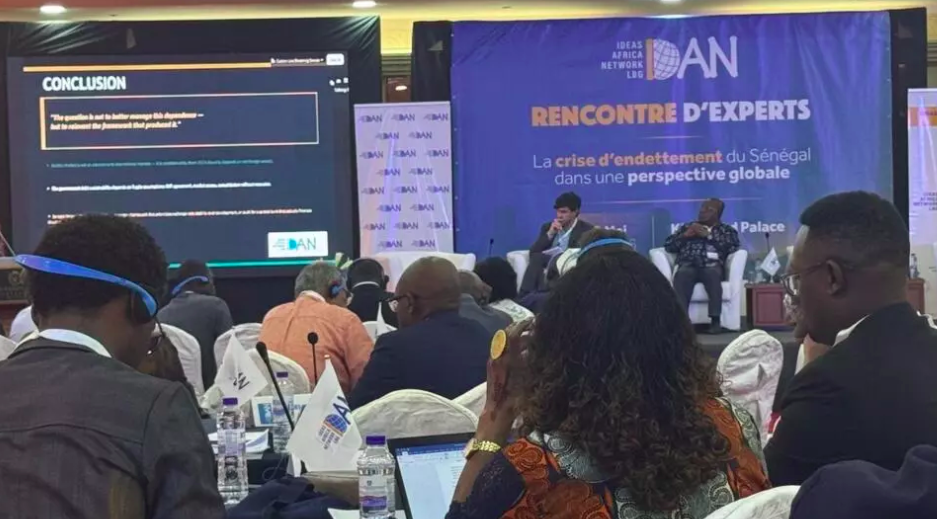
Leading economists convening in Dakar recently put forward a compelling strategy for Senegal: a significant diversification of the nation’s financial partnerships and its borrowing sources. This proposal aims to address the country’s escalating debt crisis effectively.
These experts were key participants in a critical conference focused on “Senegal’s Debt Crisis,” highlighting urgent economic challenges.
The current administration in Senegal has disclosed uncovering previously undeclared financial commitments made by the former leadership between 2019 and 2024. While former President Macky Sall has refuted these claims, officials assert that these hidden obligations contributed to Senegal’s national debt soaring to an alarming 132% of its Gross Domestic Product.
Demba Moussa Dembélé, a prominent Senegalese economist, urged national authorities to seek financial cooperation with nations that demonstrate greater respect for state sovereignty, contrasting them with traditional multilateral institutions. He specifically identified China as a potential partner in this regard.
”These are partners who can help us break free from the neocolonial system,” stated Mr. Dembélé, who presides over the African Research and Cooperation for Endogenous Development, an organization dedicated to fostering development rooted in local knowledge.
Furthermore, he strongly recommended a comprehensive and integral audit of Senegal’s public debt to fully assess its scope and origins.
Ali Zafar, an economic advisor with the United Nations Development Programme (UNDP), advised Senegalese authorities to emulate Turkey’s strategy by broadening the nation’s network of creditors. ”Turkey engaged with Saudi Arabia. Senegal could pursue a similar approach,” he explained.
”The International Monetary Fund (IMF) is not the sole source of funding,” Mr. Zafar asserted, suggesting that Senegal initiate bilateral discussions with countries like China to gain insights from their debt management expertise.
He emphasized that ”nations like Senegal must approach negotiations with the IMF equipped with robust counter-proposals.”
During debt-related discussions with the IMF, Mr. Zafar advised, Senegal must prioritize safeguarding crucial social sectors, including education and health.
He further argued that the IMF should refrain from imposing rigid conditionalities on states facing financial distress.
”It is unsustainable to allocate all national revenue to debt servicing or to use new international loans simply to repay existing creditors,” the UNDP advisor firmly stated.
In his view, ”it is imperative for African nations to present all viable alternatives and objections” in these financial dialogues.
He believes Senegal should undertake a fresh debt evaluation to gain a clearer understanding of the full scope of its financial challenges.
The UNDP advisor also suggested that, given the depth of the debt crisis, the country should consider establishing an independent central bank.
”No Asian nation would tolerate the situation Senegal currently faces,” he emphasized, concluding that ”concrete solutions exist for the country to implement with full sovereignty, enabling it to escape the debt crisis and reduce reliance on the IMF.”
Meanwhile, negotiations between the IMF and Senegal are ongoing. High-ranking Senegalese officials, including Alioune Diouf, the Director of Debt at the Ministry of Finance and Budget, held discussions with the financial institution’s leadership in Washington at the end of April.