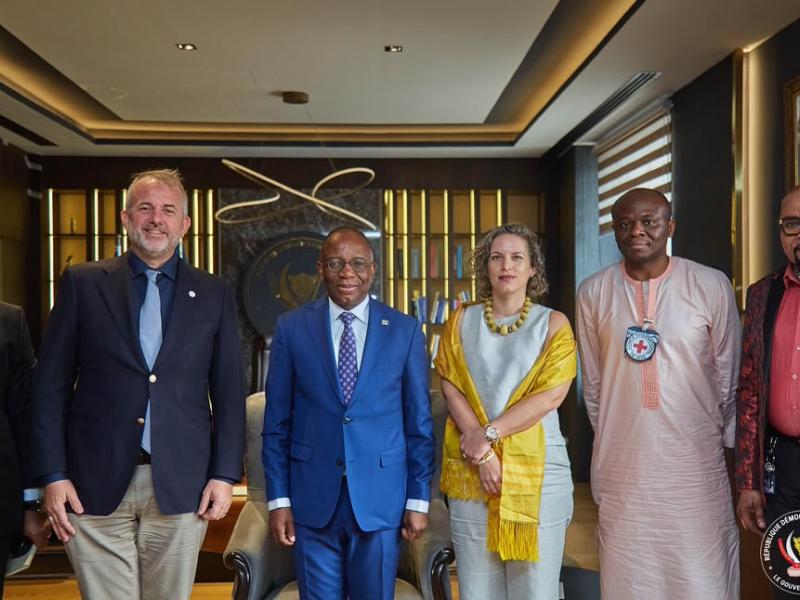
The Government of the Democratic Republic of the Congo (DRC) and the International Committee of the Red Cross (ICRC) have formalized a strengthened partnership aimed at improving detainee conditions and expanding humanitarian assistance, particularly in the eastern regions of the country. The agreement was solidified during a high-level meeting on July 14, 2026, between ICRC delegation head François Moreillon and Guillaume Ngefa Atondoko Andali, Deputy Prime Minister and Minister of Justice.
a renewed commitment to humanitarian action
The discussions centered on a comprehensive review of the existing cooperation, with both parties acknowledging significant progress over recent years. The ICRC delegation emphasized the quality and depth of collaboration maintained with the Congolese Ministry of Justice, highlighting key areas of focus such as prison conditions, detainee treatment, and adherence to international humanitarian law.
François Moreillon outlined the primary objectives of his visit, stating, “The purpose of my meeting with the Minister was to express gratitude for the sustained partnership between the ICRC and the Ministry of Justice. After three years in the DRC, this was an opportunity to assess our progress and explore ways to further strengthen our collaboration. Our shared efforts have centered on improving detention conditions, particularly in the eastern provinces, where humanitarian needs remain acute.”
The ICRC delegation leader also underscored the importance of sustainable solutions to challenges faced by the Congolese justice system, including prison financing, detainee nutrition, and the need for better legal protections for those deprived of liberty.
eastern DRC: a focal point for humanitarian interventions
The eastern provinces of the DRC, including North Kivu and South Kivu, continue to experience protracted conflict and instability, leading to severe humanitarian challenges. The ICRC has maintained a strong presence in the region, facilitating the release and transfer of detainees as part of its neutral humanitarian mandate. Between April 30 and May 15, 2025, the organization supported the transfer of over 1,300 individuals, including ex-combatants and their families, from Goma to Kinshasa—a journey spanning nearly 2,000 kilometers across active conflict zones.
These operations were conducted in coordination with the DRC Ministry of Defense, the United Nations Organization Stabilization Mission in the DRC (MONUSCO), and the armed group AFC/M23, demonstrating the ICRC’s role as an impartial intermediary in conflict resolution.
looking ahead: shared ambitions for a more humane justice system
The ICRC expressed optimism about the future of its partnership with the Congolese authorities, noting a newfound momentum in addressing systemic challenges within the justice system. Moreillon stressed, “The relationship between the ICRC and the Ministry of Justice has reached a new level of ambition. We are hopeful that these efforts will yield lasting solutions for detainees and ensure better protection of their rights.”
Since establishing operations in the DRC in 1978, the ICRC has played a pivotal role in supporting victims of armed conflict and violence, promoting compliance with international humanitarian law, and advocating for the integration of these principles into national legal frameworks. Despite ongoing security and humanitarian crises, the organization remains committed to advancing its mission in the DRC.
key takeaways
- Strengthened collaboration: The ICRC and the DRC government have reaffirmed their commitment to improving detainee conditions and expanding humanitarian assistance, particularly in the eastern provinces.
- Humanitarian operations: The ICRC has facilitated the transfer of over 1,300 detainees and their families, demonstrating its role as a neutral intermediary in conflict zones.
- Sustainable solutions: Both parties have highlighted the need for long-term strategies to address prison financing, detainee nutrition, and legal protections.
- Ongoing challenges: The eastern DRC continues to face significant humanitarian and security challenges, underscoring the importance of continued international support.