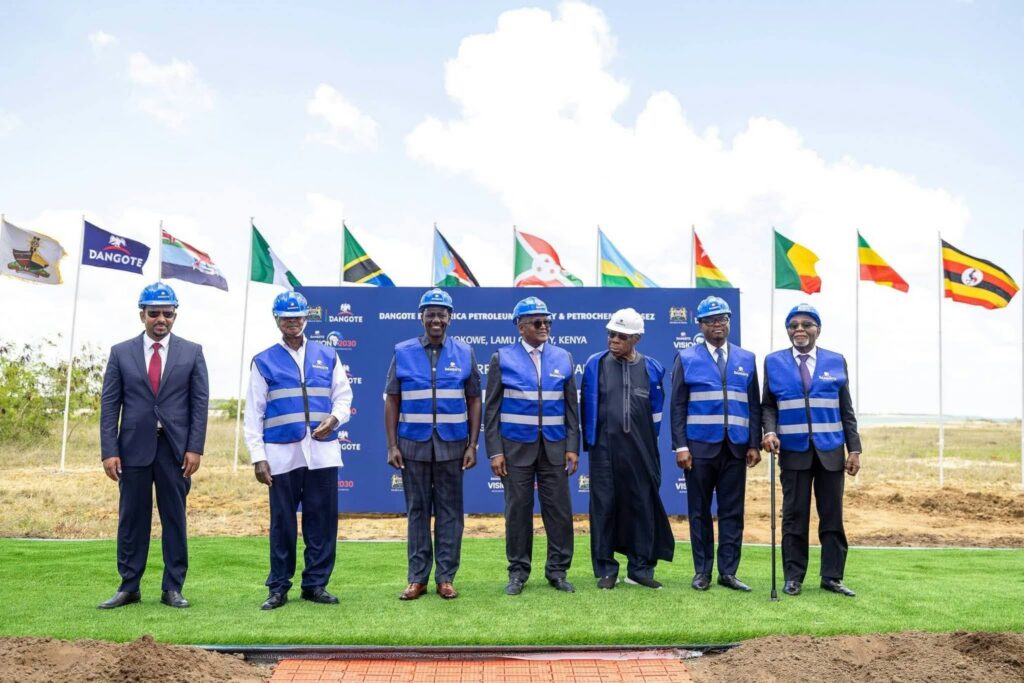
Lamu, Kenya — The turning point came quietly, but its weight was unmistakable. On Wednesday, Benin’s President Romuald Wadagni stood on Kenya’s northern coast at Lamu, joining the groundbreaking ceremony for East Africa’s future refinery — a project driven by the conglomerate of Nigerian billionaire Aliko Dangote. The moment marked a decisive shift: a West African leader planting his country’s flag at the heart of a mega-project that could redraw the continent’s energy map.
A decisive gathering of African leaders at Lamu
Wadagni was not alone. He stood alongside Ugandan President Yoweri Museveni, Togolese President Jean-Lucien Savi de Tové, Ethiopian Prime Minister Abiy Ahmed Ali, and Kenyan President William Ruto. Their joint presence at the launch underscored a critical momentum: this is no longer just a Kenyan project — it is a continental statement.
The $16 billion bet: redefining East Africa’s refining capacity
The refinery at Lamu carries an investment estimate of $16 billion, roughly 8,960 billion CFA francs. Once fully operational, it is designed to process 700,000 barrels of crude oil per day. That capacity would rank it among Africa’s largest industrial complexes and, according to project data, make it East Africa’s biggest refining project by far.
Beyond the figures, the initiative arrives at a time when numerous African nations are pushing to strengthen local processing of raw materials and cut their reliance on imported refined petroleum products.
A ceremony with a clear continental dimension
The participation of Romuald Wadagni alongside several heads of state and government reflects the continental scale given to this initiative. The simultaneous presence of leaders from West and East Africa signals a shared intent to elevate the Lamu project beyond Kenya’s borders.
For Benin, the president’s attendance was a chance to observe firsthand the opportunities generated by large-scale African industrial investments and the emerging dynamics of economic cooperation between states.
The Lamu project fits into an Africa where energy infrastructure is playing an increasingly central role in development strategies, economic sovereignty, and regional integration.
Industry at the core of Africa’s ambitions
With its announced eventual capacity of 700,000 barrels per day, the future Lamu refinery is positioned as an exceptional infrastructure. Its construction is expected to mobilize substantial capital and create an industrial ecosystem around energy, transport, and logistics.
The ceremony on 30 September 2026 stands as a major rendezvous for the leaders present. For Romuald Wadagni, it offered a singular opportunity to take part — alongside several African counterparts — in a sequence dedicated to one of the continent’s most significant industrial projects currently on the table.
At Lamu, attention is firmly on the future: an Africa striving to expand its industrial capacity and process more of its resources on its own soil.