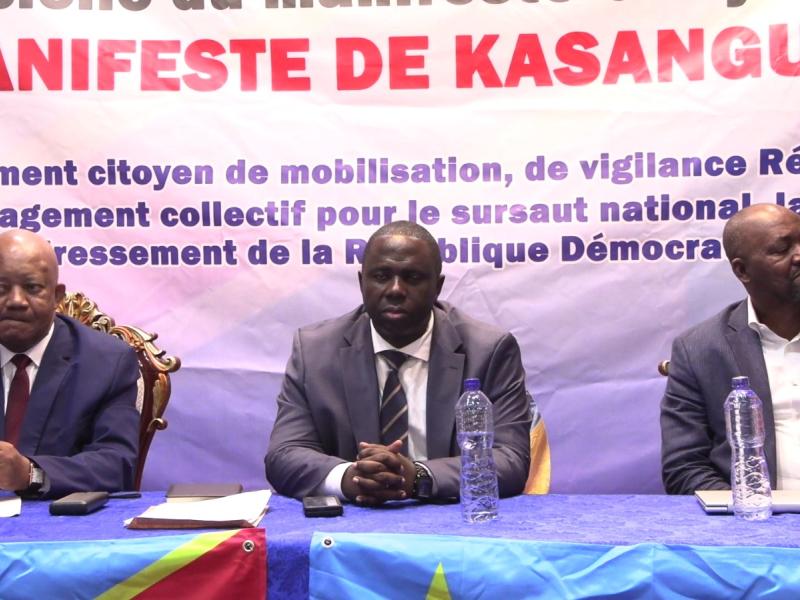
The Crisis Committee of Civil Society for Peace and Security in the Democratic Republic of Congo (CCPS-RDC) organised the official launch of the Citizen Manifesto on Friday, June 26, 2026, in Kinshasa. Organisers describe this document as a guiding framework for the nation’s refoundation and recovery. Known as the ‘Manifeste de Kasangulu,’ the text represents a collective answer to the many political, security, economic, social, and institutional challenges currently facing the country.
Developed through a participatory process that brought together representatives from several provinces, the manifesto proposes a shared vision of national transformation. This vision is based on responsible governance, peace, security, social justice, civic participation, education, health, economic development, environmental protection, and strengthening the rule of law.
The launch ceremony was opened by Ms Sylvie Nakweti, director of Communication, Advocacy and Documentation at DYCOD-RDC, who praised the commitment of civil society organisations to this drive for national renewal.
Professor Iyoka Jean Bedel then took the floor. He stressed that the Citizen Manifesto is the result of an inclusive and educational approach aimed at providing the Democratic Republic of Congo with a foundation for reflection and action for its reconstruction.
“The Citizen Manifesto is the fruit of an educational and inclusive process intended to give the Democratic Republic of Congo a basis for thought and action for its rebirth,” he stated.
The official presentation of the document was carried out by Me Patient Bashombe Matabishi, coordinator of the CCPS-RDC. He emphasised the historic significance of this initiative, explaining that the country is going through a deep crisis that requires national mobilisation.
“Today we launched the Citizen Manifesto, called the Manifeste de Kasangulu, because the commission tasked with drafting it worked in Kasangulu. This manifesto presents civil society’s vision for Congo’s recovery. We all agree that our country is experiencing a historic crisis. The question is how to emerge from it. The Citizen Manifesto is meant as a response and a path to follow for the recovery and refoundation of Congo,” Me Patient Bashombe Matabishi explained.
He also highlighted the symbolic timing of the launch, just days before the celebration of national independence.
“The choice of date is highly symbolic, coming on the eve of June 30, the day we celebrate our country’s independence. We wanted to take part in the national debate, but above all to make each Congolese person aware of their responsibility before history. This debate must not be reserved for political actors alone. Congo belongs to all Congolese. Above all, the Citizen Manifesto is an expression of citizens. It is a call to all patriots to defend the Democratic Republic of Congo,” said Me Patient Bashombe Matabishi.
The presentation of the ideological current to accompany the popularisation of the manifesto was led by Mr Daie Mutombe Pierrot, president of the Congolese Onusians. He outlined the Democratic Citizen Revolution, carried by the BLOC-RDC movement, which aims to promote active citizenship, good governance, and national sovereignty. On this occasion, Me Patient Bashombe Matabishi was elected president of BLOC-RDC, while Professor Iyoka Jean Bedel was appointed secretary-general.
When asked about the debate on a possible revision or amendment of the Constitution, the CCPS-RDC coordinator reiterated civil society’s position. He insisted on the need for broad consensus regarding the so-called ‘locked’ constitutional provisions. He also reaffirmed the ambition of the Citizen Manifesto, which in his view should be taken into account in the constitutional reform discussion.
“Revision is provided for by the Constitution itself. However, we believe that any approach that does not take all provinces into account and that does not contribute to strengthening national unity could lead to an implosion. For us, the Constitution remains the fundamental tool of national cohesion. It is the main text that unites all the Congolese people. Regarding the locked articles, which are really at the heart of the debate, we think consensus is essential,” declared Me Patient Bashombe Matabishi.
He continued:
“These provisions were locked by consensus, not by electoral means. In law, the principle of parallelism of forms means that only consensus can challenge consensus. In this dynamic, we want the Citizen Manifesto to become a founding text for the country’s future directions. It carries the vision we defend, as civil society and as the people, for the renewal of the Democratic Republic of Congo.”
Nearly 200 civil society organisations, community representatives, academics, trade unionists, lawyers, doctors, entrepreneurs, youth organisations, women’s movements, human rights defenders, and several local leaders attended the gathering. Participants praised the quality of the document and recommended launching a broad national awareness campaign to ensure its adoption across the entire national territory and within the Congolese diaspora.
Closing the proceedings, the Crisis Committee of Civil Society for Peace and Security in the DRC invited all components of the nation to embrace the Citizen Manifesto as a major contribution to the refoundation of the state, the consolidation of peace, and the construction of a more just, more prosperous, and more democratic future for the Democratic Republic of Congo.
This meeting of civil society organisations takes place against a backdrop marked by Rwandan aggression through the AFC/M23 rebellion, supported by Rwanda, as well as the activism of local and foreign armed groups. This situation further worsens the humanitarian crisis, with a growing number of internally displaced persons and refugees, amid shrinking international funding, stalled diplomatic initiatives, and ongoing hostilities in eastern DRC.
Added to this is the debate over constitutional reform. In the Democratic Republic of Congo, this issue has spawned two dynamics in the socio-political environment: on one hand, the creation of the Coalition Article 64 for the Defence of Constitutional Order (C64), and on the other hand, the Coalition of Congolese for Constitutional Change (C4). Each camp claims to enjoy popular support to achieve its set goals.