Mali’s budget under strain: the 514 billion FCFA Russian paramilitary bill
Mali’s national budget is under unprecedented pressure from sanctions and a slowing economy. At the same time, the cost of the Russian paramilitary presence — first under the Wagner Group and now under its direct successor Africa Corps, supervised by the Kremlin’s defense ministry — has reached staggering heights.
Consolidated estimates and financial leaks from the sub-region put the total amount paid to these private contingents at more than 514 billion FCFA, roughly 850 million dollars. The figure has sparked sharp controversy in Malian economic and military circles.
More than 10,000 dollars per fighter per month
Since the paramilitary organization’s initial deployment in late 2021, the monthly bill has only grown heavier. The original contract provided for an average monthly payment of about 6 billion FCFA, or 10 million dollars. But the expansion of the contingent to more than 2,000 men, the purchase of specialized equipment and support logistics have sent spending soaring.
On average, each Russian fighter or instructor costs the Malian state around 10,000 dollars per month:
- Direct mercenary salary: set at about 3,000 dollars per month.
- Supervision, equipment and combat bonus costs: nearly 7,000 dollars in additional payments collected by Russian command structures.
By comparison, the overall support of a soldier from the Malian Armed Forces (FAMA) in the field amounts to a tiny fraction of that sum — fueling quiet resentment inside local barracks.
Direct financial and mining concessions
To cope with this crushing financial burden amid severe budget shortages, transitional authorities have had to multiply payment channels. In addition to direct bank settlements routed through secure circuits, a significant share of the cost is covered by granting mining exploration titles, particularly in gold deposits in the south and west of the country.
The organization’s recent restructuring under the direct control of the Russian Ministry of Defense through the Africa Corps label has not reduced the bill. A planned increase in troop strength to 3,500 men could push the annual bill up by more than 210 billion FCFA.
What has been the security outcome?
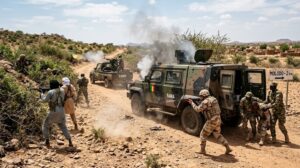
The Russian presence has enabled spectacular operations, such as the symbolic recapture of Kidal in late 2023. Yet the budget cost raises questions among analysts, given the persistently deteriorating security context. Vital road corridors face regular blockades, the center of the country remains under intense pressure from groups affiliated with JNIM, and the Malian army suffers regular losses in complex ambushes.
For many economic observers in Bamako, allocating more than 514 billion FCFA to foreign praetorian guards and mercenaries deprives essential public services — electricity, health and education — of vital resources. It also locks the transitional government into total financial and security dependence on Moscow.