DCIM\100MEDIA\DJI_0211.JPG
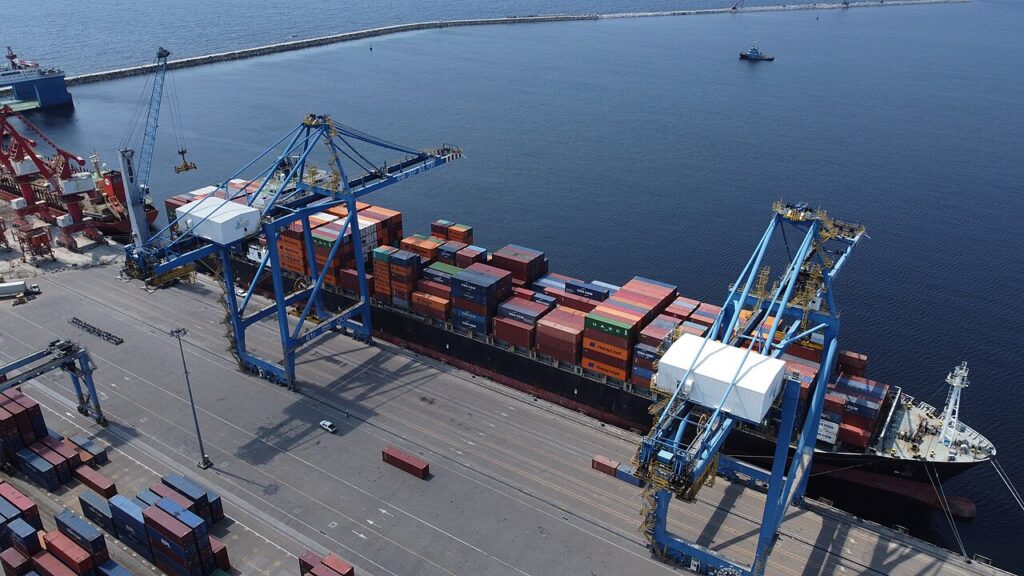
Fifteen years ago, Kribi’s outer district of Mboro was little more than a quiet fishing hamlet, its handful of homes connected by narrow, dusty dirt tracks that vanished into the coastal bush. Today, the same stretch of shoreline houses one of Central Africa’s most advanced deep-water ports, while the surrounding area hums with the energy of a rapidly expanding industrial and logistics hub.
From sand tracks to maritime powerhouse: the port’s transformation
Plans for a deep-water port to complement the shallow estuary of Douala—Cameroon’s main gateway—date back to the 1970s. After decades of deliberation, progress accelerated with the completion of the first and second phases of the Port of Kribi, a Chinese-financed megaproject that broke ground in 2010.
Gu Gaobai was among the first Chinese engineers dispatched by China Harbour Engineering Company (CHEC) to the remote site. ‘We arrived on unpaved roads that barely qualified as tracks,’ he recalled. ‘Where the port now stands, there was only a strip of sand and scattered reefs. Those rocks were the only landmarks pointing to where the future harbor would rise.’ Today, Gu serves as CHEC’s country director in Cameroon, overseeing a portfolio that has helped redefine the region’s economic landscape.
Everyday gains: how trade and traffic changed local lives
For residents like Jean-Kalvin Assembe, a 50-year-old lifelong Kribi resident, the changes are felt in daily routines. ‘Before the port, getting around meant wrestling with rutted tracks after every rain,’ he said. ‘Now we have well-lit dual carriageways, pedestrian crossings, and constant traffic of trucks and container handlers. Even neighborhood kiosks see steady business.’
Yaya Aboubakar, a 68-year-old haulage veteran who has driven trucks across four Central African countries, said the port has streamlined his work. ‘Shipments clear faster than ever, and the roads are smoother. Kribi feels like a gateway to opportunity,’ he noted.
The port’s after-dark glow—security lighting that keeps the terminals operational round the clock—has made the area safer, while new hospitals, universities, and shopping centres have sprouted around the city. ‘Before, we relied on makeshift clinics,’ Assembe said. ‘Now we have modern facilities within minutes of home.’
Industrial zone on fast track: jobs, investment, and regional reach
Since launching operations in 2018, the Kribi Industrial Zone has become a magnet for manufacturing and logistics firms. Patrick Mpila Ayissi, infrastructure lead at the zone, reports that industrial investment has topped 400 billion Central African francs (around $700 million), with 93 land-use permits issued and 18 companies already in production.
The zone’s ambition has expanded from an initial 455 hectares to a 4,000-hectare integrated industrial park. Official projections anticipate $900 million in new investment and 50,000 direct jobs over the next 15 years, with indirect employment potentially reaching 150,000. The port is already a regional hub, linking Cameroon to Gabon, Central African Republic, Chad, Republic of the Congo, and Equatorial Guinea through services provided by global carriers such as MSC.
‘Container traffic has quadrupled since 2018, hitting more than 555,000 TEUs in 2025,’ Ayissi said. ‘Total cargo volume exceeded 12.7 million tonnes in 2024, reinforcing Kribi’s role as Central Africa’s most dynamic deep-water gateway.’
Skills built, lives transformed: the human impact of the project
Local workers have not merely witnessed change—they have helped build it. Ngatugirius Ndenya left a welding job in Yaoundé in 2013 to join CHEC’s team at Kribi. ‘My first months were tough,’ he admitted. ‘But pairing Cameroonian apprentices with seasoned Chinese mentors gave me hands-on training I never received in school.’ Today, Ndenya oversees welding crews and trains new hires—skills he says would have been inaccessible without the port project.
For others, the transformation is measured in bank balances and family stability. Armand Guehoada arrived at the site with virtually no savings after leaving his previous job, where he earned roughly 100,000 Central African francs a month. ‘Within a few years, I bought my first car,’ he recalled. ‘Now I own three, and I send my children to better schools. The port didn’t just give me a job—it gave me a future.’
CHEC reports training hundreds of Cameroonians in port construction and large-scale engineering, many of whom now lead roles in nearby industrial ventures. ‘Fifteen years ago, Mboro had no port engineers,’ Gu Gaobai said. ‘Today, it has dozens who are shaping the next phase of the country’s industrial rise.’
A partnership etched in steel and concrete
This year marks 55 years since China and Cameroon established diplomatic ties—and 15 years since ground was broken on the deep-water port of Kribi. Officials credit concessional financing from Chinese institutions as the foundation of a long-term partnership that has delivered tangible dividends. ‘Kribi stands as a symbol of sustained South-South cooperation,’ Ayissi said. ‘Its cranes and berths are more than steel and concrete—they represent shared progress.’
Patrice Melom, director-general of the Port Authority of Kribi, sees the facility as a catalyst for national prosperity and regional integration. ‘We have the infrastructure, the momentum, and the demand,’ he said. ‘Our mission now is to harness every opportunity so that Kribi powers sustainable growth across Cameroon and beyond.’