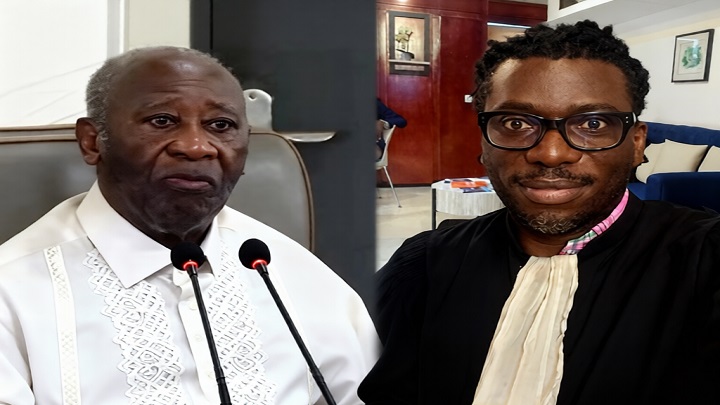
The reappointment of Laurent Gbagbo as the leader of the Parti des Peuples Africains – Côte d’Ivoire (PPA-CI) continues to intensify discussions across the Ivorian political landscape. Following the party’s inaugural ordinary congress in Abidjan, attorney Ange Rodrigue Dadjé put forth the argument that previous criticisms aimed at President Alassane Ouattara regarding his sustained political presence are no longer merited.
“Ultimately, there should be no further reproaches directed at President Ouattara for his decision to remain in politics, despite his earlier expressed intentions of political retirement,” Dadjé stated on Friday, May 15, 2026. This pronouncement has already provoked widespread discussion within political circles and across social media platforms.
This declaration emerges at a critical juncture, marked by Laurent Gbagbo’s undeniable resurgence in the political spotlight of Côte d’Ivoire. Many observers had anticipated the former head of state would progressively withdraw from active politics, yet the PPA-CI congress decided by acclamation to keep him at the party’s helm. This stands in stark contrast to Gbagbo’s earlier pronouncements, where he hinted at a desire to step back. In an interview with journalist Alain Foka on AFO Media on October 22, 2025, the former Ivorian president had clearly articulated his plan to avoid future political office after the December 2025 legislative elections.
“There is no true retirement in politics, but I will refrain from holding political functions, both within my party and in the state. I have contributed enough,” he had affirmed. At 81 years old, the former president, who received a definitive acquittal from the International Criminal Court (ICC) in 2021, seemed poised to gradually cede influence to a new generation of PPA-CI executives. However, the party’s first ordinary congress, convened on May 14 and 15, 2026, in Abidjan, took an unexpected turn.
Addressing party activists and leaders, Laurent Gbagbo ultimately pledged to persist in the political arena. “I remain for the fight,” he announced to the applause of the delegates, thus concluding all conjecture regarding his final exit. For numerous analysts, this decision unavoidably reignites the enduring discussion about the sustained political roles of prominent Ivorian figures, particularly that of Alassane Ouattara.
As recently as 2020, the head of state ignited considerable controversy by declaring his pursuit of a third presidential mandate, after having previously indicated his intention to hand over power to a new generation. At that time, the opposition, including Laurent Gbagbo’s PPA-CI, strongly denounced this policy shift, viewing it as a departure from the Ivorian leader’s earlier commitment. However, for Ange Rodrigue Dadjé, the current situation within the PPA-CI demonstrates how the practicalities of politics often supersede initial pledges made by leaders.
In July 2025, Alassane Ouattara had formally announced his intention to seek a fourth presidential term in the October 2025 elections. Then 83 years old, he justified his decision by underscoring the imperative of national stability amidst evolving regional security and economic landscapes. “This carefully considered decision is a duty,” the Ivorian president stated, asserting that he was acting in the “supreme interest of the Nation.”
Laurent Gbagbo’s reappointment at the helm of the PPA-CI now appears to reshape the landscape of Ivorian political discourse. Many now interpret it as an illustration of the significant sway held by party loyalists and internal political dynamics over the choices of political leaders, even when those leaders had previously announced their intention to step down. In political headquarters and among the general public, this development revives a persistent question within Côte d’Ivoire: can historical figures truly withdraw from the political stage as long as their supporters continue to demand their leadership?