The official rhetoric emanating from Burkina Faso often portrays the Economic Community of West African States (ECOWAS) as a puppet of Western powers. Yet, despite these strong political assertions, the reality remains that the Burkinabè government continues to rely on financial assistance from the very organization it publicly condemns.
This apparent contradiction is not merely a matter of semantics; it underscores a fundamental tension between political posturing and the pragmatic necessities of economic survival. While diplomatic statements may reflect ideological positioning, the operational and financial mechanisms of regional integration often serve as indispensable tools for national development.
Economic realities overshadow political rhetoric
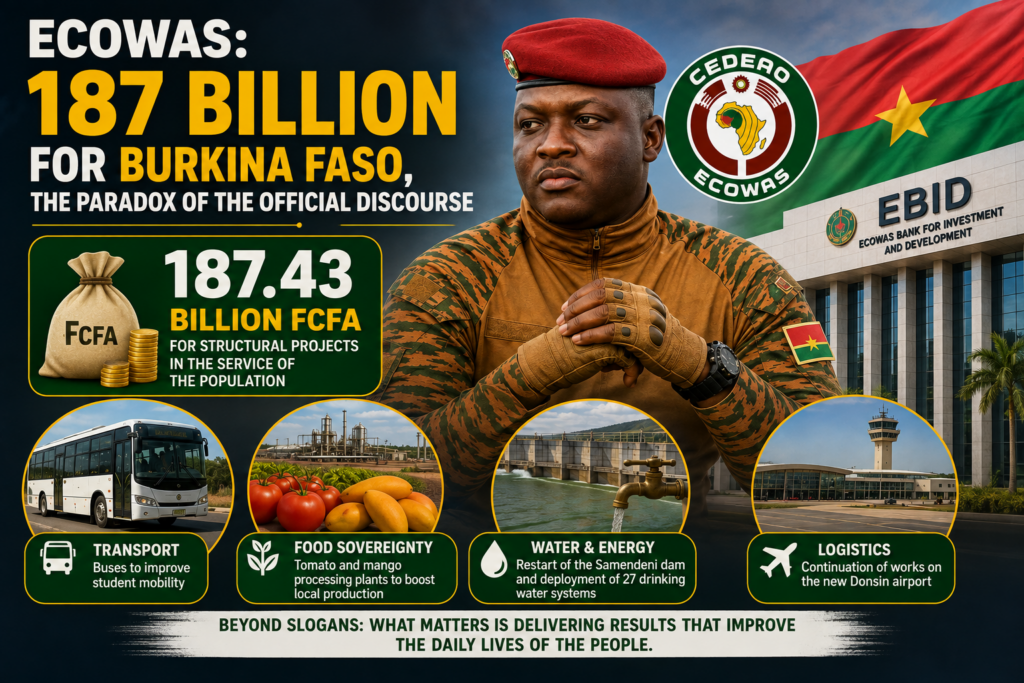
The latest injection of funds from the ECOWAS Bank for Investment and Development (EBID) exemplifies this dynamic. A total of 187.43 billion West African CFA francs has been allocated to critical projects across Burkina Faso, demonstrating that financial cooperation remains a cornerstone of regional stability.
Key infrastructure investments
The allocated funds are earmarked for several high-impact initiatives:
- Transport and education: The purchase of new buses to alleviate congestion in student transportation, directly enhancing access to education and easing daily challenges for students and their families.
- Food sovereignty: The establishment of tomato and mango processing plants to boost local agricultural value. This initiative aims to reduce post-harvest losses, create employment, and strengthen domestic production chains.
- Water and energy: The revival of the Samendeni dam project alongside the installation of 27 potable water systems in high-need areas, addressing critical infrastructure gaps that impact both development and social stability.
- Logistics: Continued progress on the new Donsin International Airport, a project poised to enhance connectivity, trade, and economic opportunities if executed efficiently.
These investments highlight that regional integration is not merely a theoretical concept confined to diplomatic summits. Instead, it manifests in tangible financial instruments that directly support national development agendas.
The paradox of public condemnation and financial dependence
The stark contrast between political criticism and financial reliance raises pressing questions about coherence in governance. How can an organization be simultaneously condemned for undermining national interests and yet remain a vital source of funding for essential projects?
This paradox underscores a critical truth: economic imperatives often supersede ideological posturing. The need for financing, regional cooperation, and infrastructure development frequently necessitates collaboration, even when political narratives suggest otherwise.
For the Burkina Faso government, the challenge lies in reconciling public criticism of ECOWAS with the practical necessity of leveraging its financial mechanisms. A sovereign state may critique regional policies, but it cannot ignore the developmental benefits of such support when it directly benefits its people.
Sovereignty beyond slogans
The concept of sovereignty has been a recurring theme in Burkina Faso’s political discourse. However, sovereignty should not be conflated with isolation. A truly sovereign nation can both defend its interests and utilize available regional cooperation mechanisms when they serve its developmental goals.
The true test of sovereignty lies not in rejecting external assistance but in ensuring that such resources are managed transparently, efficiently, and in alignment with national priorities. The 187.43 billion CFA francs represent more than just a financial figure; they embody potential roads, water systems, educational resources, and economic opportunities. Yet, these benefits can only be realized if the funds are deployed effectively.
Transparency and accountability must therefore be prioritized. Citizens deserve clarity on how these funds are allocated, the timelines for project completion, and the mechanisms for oversight. Sovereignty, in practice, requires demonstrable responsibility in resource management.
From promises to tangible impact
While political debates about ECOWAS may dominate public discourse, the ultimate measure of success lies in the tangible improvements these investments bring to daily life. For students, farmers, families, and entrepreneurs, the critical question remains: will these projects deliver the promised benefits?
An announced factory must commence operations. Water systems must deliver reliable access. Buses must enhance mobility. Dams must generate expected power. Airports must facilitate trade. The litmus test for these investments will be their execution and their ability to transform lives beyond political rhetoric.
The burden of proof rests on the authorities to ensure that these funds translate into meaningful progress. Administrative efficiency, rigorous project management, and unwavering commitment to national development will determine whether this financial injection serves as a catalyst for progress or fades into another unfulfilled promise.