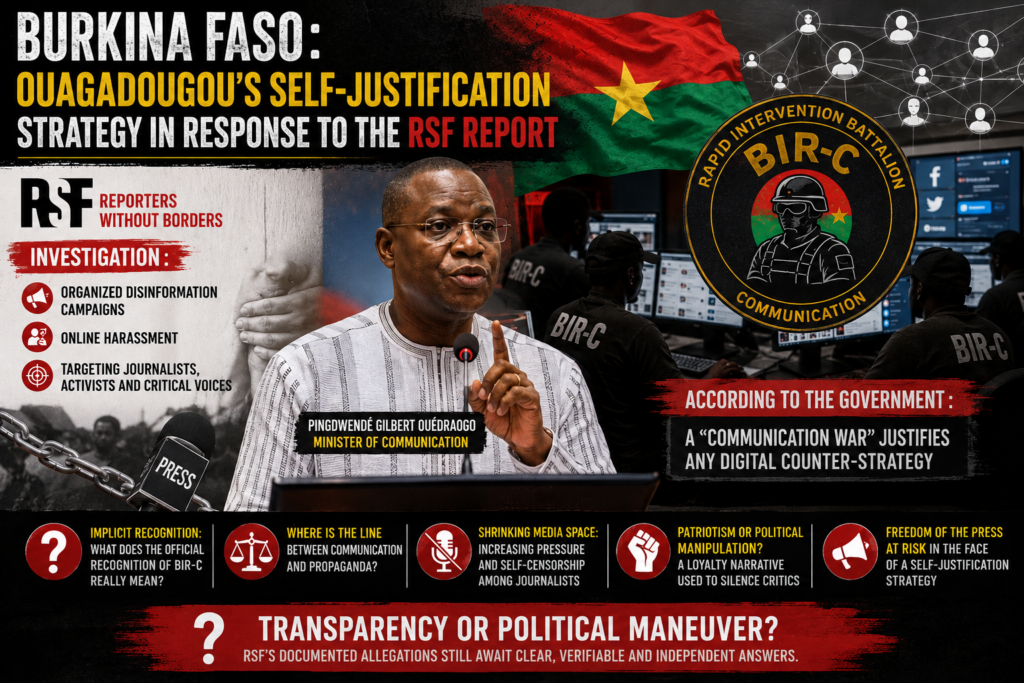
Burkina Faso’s governmental response to allegations of a coordinated disinformation campaign has taken a defensive turn, raising serious questions about transparency and press freedom. During the national flag-raising ceremony on August 3, the Minister of Communication, Pingdwendé Gilbert Ouédraogo, publicly endorsed the Rapid Intervention Battalion – Communication (BIR-C), branding it as a protective mechanism for the country’s public information efforts.
The endorsement comes in the wake of an investigation by Reporters Without Borders (RSF), which uncovered a complex network of social media accounts suspected of spreading disinformation, targeting journalists, and silencing critics of the transitional military government. Rather than addressing the evidence through an independent review or refuting the findings directly, the Burkinabè authorities chose to publicly champion the BIR-C, a decision that has only intensified scrutiny over its true objectives.
According to the RSF report, the network in question leveraged both fabricated and real accounts to manipulate narratives, undermine opposition voices, and exert relentless pressure on independent media. While the government dismisses these accusations, its reflexive defense of the BIR-C—without substantively engaging with the documented evidence—has fueled speculation about the unit’s broader role within the nation’s communication strategy.
Official rhetoric frames the situation as a defensive response to an external propaganda war aimed at destabilizing Burkina Faso. In this narrative, any digital or communicative countermeasure is portrayed as a patriotic necessity. Yet this justification raises a pressing concern: where does legitimate crisis communication end, and where does state-sanctioned suppression of dissent begin?
Balancing security and freedom in times of crisis
In a period marked by political and security fragmentation, combating misinformation is a legitimate concern for governments worldwide. However, international standards on freedom of expression explicitly prohibit the use of state communication tools to harass, smear, or intimidate journalists. As criticism increasingly becomes conflated with treason, public discourse risks becoming dangerously restricted, undermining the very principles of an open society.
The controversy surrounding the BIR-C unfolds against a backdrop of deteriorating press freedom in Burkina Faso. With several international media outlets suspended and independent journalism facing mounting pressure, professionals within the sector are increasingly adopting self-censorship as a survival tactic. In this environment, the existence of a centralized digital communication structure—especially if its operations extend beyond official messaging—presents a critical dilemma: how can national security imperatives coexist with the preservation of fundamental freedoms?
A strategic pivot from accountability to patriotism
The minister’s public endorsement of the BIR-C did little to clarify its functions or address allegations of wrongdoing. Instead, it reframed the debate, transforming it from a question of operational integrity into one of national loyalty. By emphasizing the supposed patriotism of BIR-C personnel, the government shifted the narrative from evidence-based scrutiny to emotional appeals, effectively recasting criticism as an attack on the state itself.
Yet a resilient democracy facing profound challenges is measured not only by its security strategies but by its ability to endure—and even welcome—scrutiny from free press and human rights organizations. Publicly endorsing an accused entity in response to serious allegations does little to bolster credibility; rather, it risks being interpreted as an endorsement of its role within the state’s broader communication apparatus.
Implications for digital governance and press freedom
The stakes of this controversy extend far beyond the BIR-C. They touch on the future of information management in Burkina Faso, particularly as social media platforms become the front lines of political and ideological battles. Any government-linked structure tasked with managing digital communication must operate within a framework of transparency, accountability, and strict adherence to human rights standards. Failure to do so risks eroding public trust and further restricting the space for pluralistic dialogue.
Ultimately, this episode illustrates a stark political choice: prioritizing patriotic mobilization over transparent engagement with criticisms. Without providing concrete, verifiable, and independent responses to the allegations raised by RSF, official statements risk being dismissed as mere self-justifications—perpetuating a communication system whose opacity continues to cast shadows over Burkina Faso’s commitment to press freedom.