Government decree sparks debate over cultural freedoms
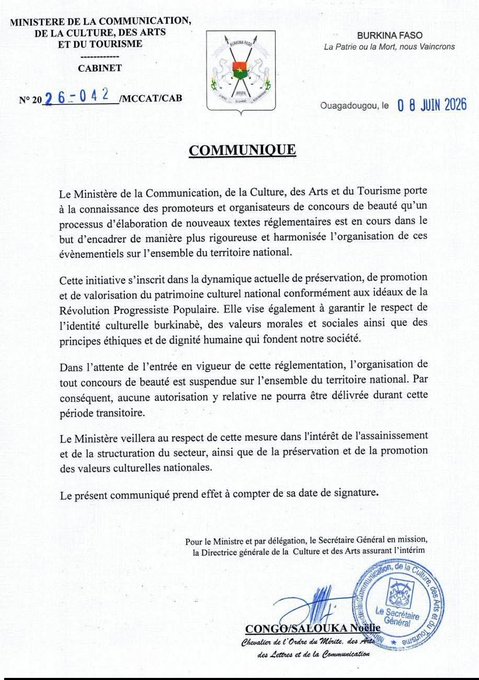
The issuance of an official decree has sent shockwaves through Burkinabè society. Authorities have suspended all beauty pageants nationwide indefinitely, citing a need to uphold cultural values and align with the country’s ongoing security crisis. Yet beneath this justification lies a more troubling agenda: the systematic dismantling of civic freedoms under the guise of governance.
Security crisis as a backdrop for cultural restrictions
With the nation grappling against persistent security threats and humanitarian instability, the timing and nature of this restriction raise critical questions. Why target beauty competitions when national security demands immediate attention?
Seasoned observers of the region suggest this move is no accident. It reflects a deliberate political maneuver—diversion. By shifting public discourse toward debates on morality and social conduct, authorities aim to deflect scrutiny from their failure to restore constitutional order or stabilize the territory.
State-imposed morality as a tool of control
The ban on beauty pageants is not an isolated incident but part of a broader pattern of state interference in private and public life. Under the pretext of moral recalibration, the regime is quietly laying the foundation for an authoritarian framework where personal expression is tightly regulated.
A human rights advocate, speaking on condition of anonymity, warns of the slippery slope this represents: “First, they ban a beauty contest in the name of values. What’s next? Will clothing styles, artistic works, or even dissenting ideas be prohibited under the same rationale?”
This inclination to police bodies, leisure, and cultural expression is a hallmark of autocratic regimes. The approach is insidious—no tanks roll through the streets, but decrees suffocate freedom, infantilizing citizens by dictating what is deemed ‘worthy’ of celebration.
The slow suffocation of Burkinabè democracy
The implications of this decision extend far beyond fashion or pageantry. It signals a deliberate narrowing of civic space. Following the suspension of opposition parties, the muzzling of independent media, and the detention of dissenting voices, the assault now extends to cultural industries.
A masked dictatorship reveals itself not through brute force alone, but through legal arbitrariness and the weaponization of morality. By depriving youth and cultural actors of their platforms for expression and entertainment, the transitional government sends an unmistakable message: ideological conformity is mandatory, and even aesthetic dissent is no longer acceptable.
Behind the rhetoric of sovereignty and moral guardianship, Burkina Faso is edging ever closer to a monolithic social order—one where the state dictates norms for all. A path that, cloaked in protection, bears a familiar name in political history: authoritarianism.