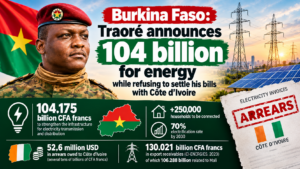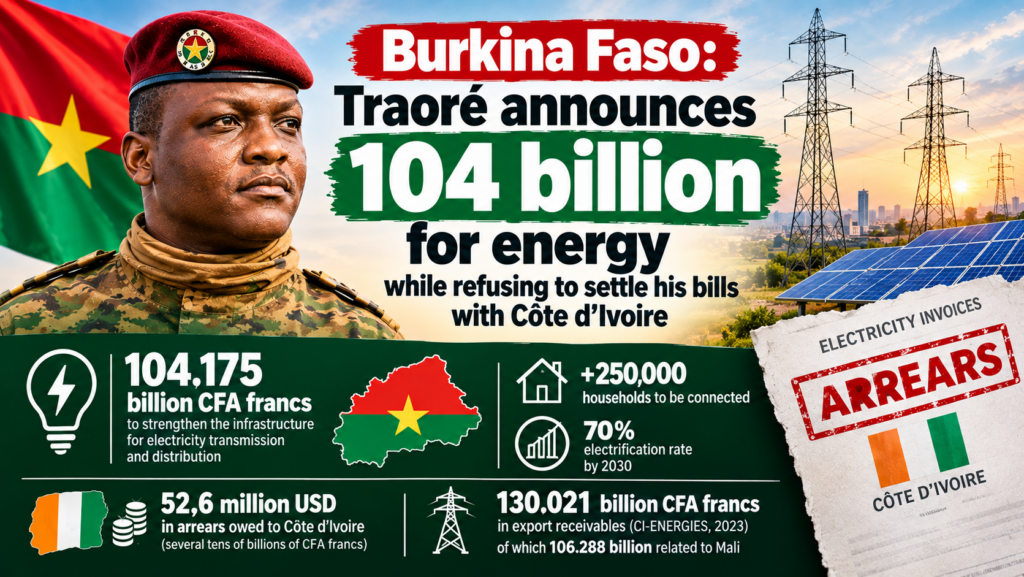
The Burkinabè government has approved a financing envelope of 104.175 billion CFA francs to expand and modernise the infrastructure that carries and distributes electricity, connect more than 250,000 households and push the national electrification rate up to 70 percent by 2030. The initiative sits inside the country’s National Energy Pact and the RELANCE 2026-2030 programme.
On paper, the numbers land well. They promise poles, transformers, lines and meters — the physical machinery of a grid that reaches further than it does today. The harder question is the one that rarely makes it into a press release: where the money will come from, and whether Burkina Faso’s finances can carry the weight of a promise this size.
Money already owed, before a single new line is built
New construction is only part of the bill. The country is already carrying obligations from earlier years. In its most recent country assessment of Burkina Faso, the International Monetary Fund records 52.6 million dollars of arrears owed to Côte d’Ivoire — a sum running into several tens of billions of CFA francs. The Fund classifies the amounts as inherited external arrears and does not narrow them to electricity purchases alone.
That nuance matters, but it does not dissolve the underlying difficulty. A state that presents energy self-reliance as a strategic goal is also a state that has to settle what it owes its partners — particularly a neighbour whose grid has long helped keep the lights on.
Why the distinction matters
Framing the debt as legacy rather than as payment for power changes how it reads, not whether it must eventually be paid.
Regional dependence and the pressure on Côte d’Ivoire
Côte d’Ivoire has occupied a central position in West Africa’s cross-border electricity trade for years. Documents from the African Development Bank flag unpaid balances from electricity-importing countries as a drag on the financial balance of the Ivorian power sector. In 2023, export receivables owed to CI-ENERGIES reached 130.021 billion CFA francs, with 106.288 billion of that total tied to Mali.
Against that backdrop, the debate shifts. The question is no longer how loud the announcement is, but how disciplined the finances behind it are.
Sovereignty built on contracts, not communiqués
A budget line above 100 billion francs, aimed at widening access to electricity, can be legitimate — arguably essential. Yet energy sovereignty is not declared from a podium. It is assembled from generating plants, transmission corridors, capital, suppliers who get paid on time and a treasury able to absorb the policy it has announced.
The National Energy Pact’s own test
Burkina Faso’s energy framework itself calls for improving the financial viability of the sector and for a large-scale mobilisation of investment. That language sets a benchmark the government has now set for itself.
The gap between the announcement and the treasury
The real challenge is not the headline figure. It is proving that the financing can actually be raised, that the infrastructure gets built and that past commitments are honoured rather than deferred.
Durable energy sovereignty cannot rest on a growing stack of announcements. It depends on the confidence of partners, the strength of public coffers and respect for contractual obligations.
By treating each new financing package as fresh evidence of independence, Ibrahim Traoré’s government risks concealing a contradiction at the centre of its own narrative: autonomy cannot be claimed while arrears accumulate with the neighbours whose electricity and regional infrastructure still help keep the system running.
Real energy sovereignty will begin when Burkina Faso produces more, imports less — and, above all, pays what it owes. Only then will the billions on the table become something more than a political promise: a genuine, lasting energy policy.