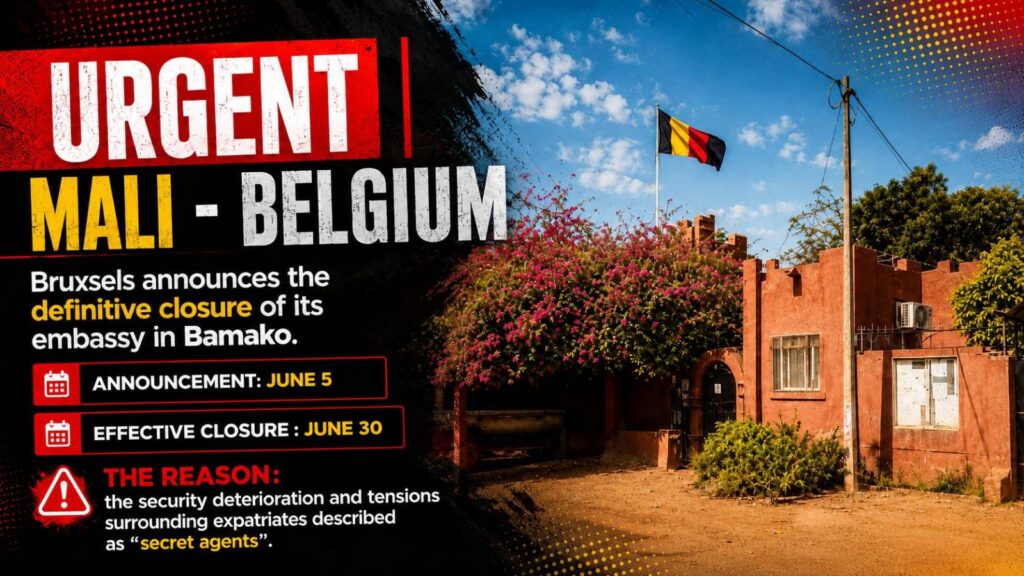
The Belgian government has confirmed the permanent closure of its embassy in Bamako, marking a historic shift in bilateral relations. The decision, announced on June 5, will take full effect by June 30, reflecting growing concerns over security and political tensions in the region.
a historic partnership comes to an end
The announcement delivered a sharp blow to Mali’s diplomatic circles. Belgium’s foreign ministry stated that the embassy’s personnel would vacate the premises by the end of the month, concluding decades of collaboration in development, humanitarian aid, and cultural exchange. The closure underscores the broader trend of Western nations scaling back their presence in the Sahel, leaving Bamako increasingly reliant on alternative alliances, particularly with Russia.
The withdrawal is significant for Mali, where Belgium had played a key role in funding vital projects across the northern and central regions. These initiatives addressed critical needs in infrastructure, healthcare, and education, supporting local communities facing persistent challenges.
escalating insecurity drives withdrawal
At the heart of Belgium’s decision lies the worsening security crisis. Since the withdrawal of French forces from Operation Barkhane and the exit of the UN’s MINUSMA mission, the Malian government has struggled to maintain stability. Terrorist groups have intensified attacks on major roads and urban centers, exacerbating an already fragile situation.
For Belgium, ensuring the safety of its diplomatic staff and citizens became untenable beyond June 30. Authorities concluded that the current political and military climate no longer allows for effective development assistance. Without reliable security guarantees, maintaining a full-fledged embassy was deemed an unjustifiable risk.
climate of suspicion targets foreign experts
Beyond the security threat, another critical factor accelerated the decision: the hostile environment toward Western expatriates. In recent months, Mali’s transitional authorities have increasingly labeled foreign experts—including aid workers and technical advisors—as suspected spies or destabilizing agents.
The arbitrary arrests of several European professionals, often without clear charges or adherence to due process, have created a climate of fear. Belgium concluded that these actions made it impossible for its diplomats and experts to operate safely, effectively halting critical development programs.
what does this mean for the Malian people?
The closure will have immediate consequences for vulnerable populations. The Belgian embassy oversees numerous aid initiatives, including clean water access, reproductive health services, and basic education. The suspension or transfer of these programs to neighboring countries will leave many communities without essential support.
For Malian citizens, obtaining visas for medical treatment, education, or business in the Schengen Zone will also become more difficult. Applicants will now need to seek assistance from other European embassies, which are already overburdened, or travel to neighboring countries for consular services.
a deeper diplomatic rift emerges
This withdrawal is not an isolated incident but part of a broader estrangement between Bamako and its traditional European partners. By embracing a confrontational stance—including the detention of foreign nationals under espionage allegations—the Malian government risks deepening its international isolation.
While some local factions may applaud this defiance of Western influence, the strategy weakens Mali’s global standing at a time when economic and security challenges demand collaborative solutions. Cutting ties with Brussels eliminates a key moderate voice within Europe, leaving Mali increasingly isolated when it needs global cooperation the most.