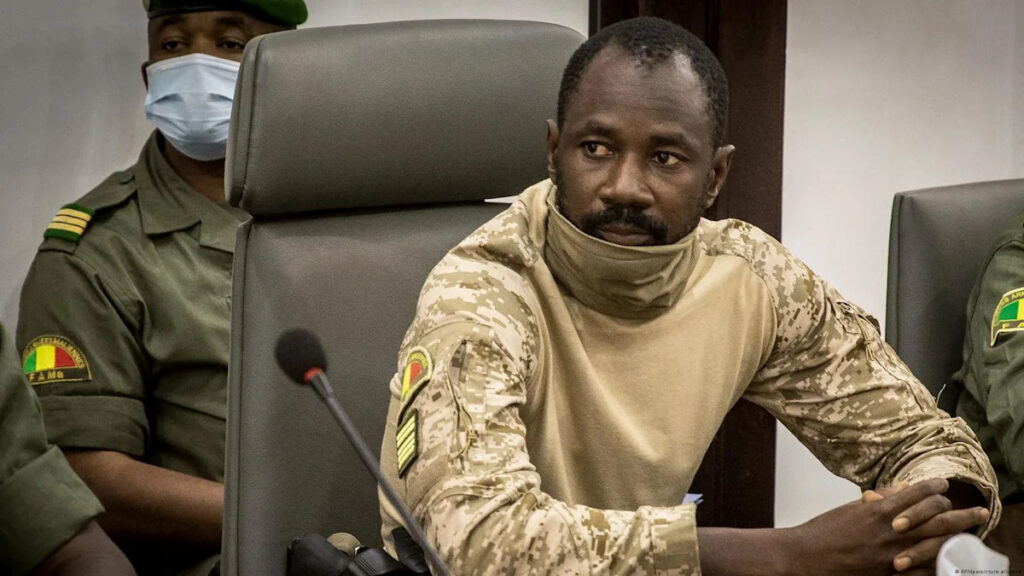
Five years have passed since General Assimi Goïta seized power in Bamako through a military takeover. Since then, Malians have witnessed a steady decline in security, shrinking civic freedoms and mounting pressure on independent voices.
In a candid assessment, Ulf Laessing, head of the Konrad Adenauer Foundation’s Sahel program in Bamako, shares his observations on the trajectory of the country under military rule. His analysis highlights a growing climate of fear, where open public debate remains possible only within trusted circles. Critical journalists and activists now face imprisonment or forced exile, silencing dissent and narrowing the space for political participation.
Security deteriorates despite military control
At the outset, the junta restored some stability in parts of the country. For a time, the road to Ségou remained open, allowing farmers to return to their lands. However, those gains have been reversed. Today, the security situation has worsened, compounded by rapid population growth, climate stress and persistent insurgent violence. Laessing expresses deep skepticism about any government’s ability to reverse these trends.
Despite initial pledges to defeat jihadist groups, control over large areas of Mali has slipped further into the hands of armed factions. The Group for the Support of Islam and Muslims (JNIM) and the Islamic State in the Greater Sahara now exercise de facto authority over vast regions, particularly in the north. Laessing believes no government—military or civilian—will be able to reclaim these territories through force alone. Even a new coup or a future elected government is unlikely to shift the balance.
In late April, coordinated attacks involving jihadists and Tuareg rebels marked a turning point. These assaults represented the largest offensive since 2012, when similar alliances briefly seized northern cities before being pushed back by international forces. The latest attacks struck at the heart of state authority. Although the government survived, it lost control of key northern towns. While rebel advances have since stalled, the damage to national prestige remains severe. The assault caught both Malian forces and their Russian allies off guard, underscoring the fragility of the security architecture.
The limits of Russian support and regional solidarity
The role of Russian mercenaries—once touted as a solution to Mali’s security woes—has proven largely symbolic. With an estimated 1,500 to 2,000 fighters on the ground, their presence falls far short of the resources France once deployed. Their heavy-handed tactics have inflamed local tensions and done little to curb insurgent activity. In a humiliating withdrawal, Russian forces abandoned positions in Kidal and other northern locations without engaging in combat, leaving Mali exposed and isolated.
The promised support from neighboring Alliance of Sahel States (AES) members—Burkina Faso and Niger—also failed to materialize. Both nations issued statements of solidarity, yet offered no meaningful military assistance. Burkina Faso and Niger face their own insurgent threats and lack the capacity to project force beyond their borders. The absence of coordinated action during the April attacks revealed the limits of regional unity, despite shared political rhetoric and ideological alignment among the three juntas.
Laessing cautions against overestimating this cooperation. While Mali, Burkina Faso and Niger share strategic goals, their economic and military constraints are immense. These are among the poorest countries in the world, struggling for survival rather than forming a cohesive defense bloc. Their cooperation remains largely rhetorical, with little tangible impact on Mali’s security challenges.
Public sentiment: fear of extremism outweighs dissatisfaction with the junta
Despite widespread frustration with military governance, public opinion does not favor a return to civilian rule or the rise of jihadist factions. Laessing notes that Malians, particularly in Bamako, reject the imposition of strict Sharia law. The April attacks sparked no mass protests or calls for the government’s resignation—a telling sign of public priorities. Citizens recognize that removing the current regime risks empowering even more hardline Islamist forces.
Many Malians continue to support the junta, not out of enthusiasm, but from a sense of necessity. The alternative—a return to the corrupt civilian elites tied to former colonial powers—is widely despised. The average age in Mali is just 15 years. A generation with limited education and minimal exposure to Western media consumes most of its news through social platforms, where pro-junta narratives and disinformation campaigns thrive. Even during moments of national crisis, such as fuel shortages or the April attacks, public demonstrations have been absent. The overriding fear is that jihadist groups would fill any power vacuum.
Laessing points to Mauritania as a potential model. After years of conflict, Mauritania combined military pressure with pragmatic compromises—such as restricting alcohol sales and adopting the title “Islamic Republic”—to reduce instability. Such measures do not require full implementation of Taliban-style governance. Instead, they reflect a middle path that acknowledges local grievances while preserving state authority. Once stability returns, governments can gradually address broader social and economic issues.
For Mali, the path forward remains unclear. Military action alone cannot resolve a conflict rooted in poverty, climate change and long-standing marginalization. Dialogue with moderate factions within armed groups may offer a glimmer of hope, but trust is nearly absent. The population, exhausted by decades of unmet promises, appears resigned to endure the status quo rather than risk chaos. Until a credible alternative emerges—or until the junta can deliver tangible improvements—Mali’s slide toward deeper instability seems likely to continue.